AI to detect and help you recover missed revenue
Automatically detect underpayments and denials, validate revenue opportunities, centralize contract intelligence, streamline recovery workflows, and strengthen payer negotiations.









Make decisions faster with RevFind’s agentic AI
Ask questions in plain English and let RevFind's AI agent do the heavy lifting, on demand or in the background. Explore data, build visualizations and forecasts, summarize insights, and uncover anomalies in your existing reports. Your always-on agent can monitor live data and flag anomalies as they surface.
%20(1).png)
%20(1).png)
%20(1).png)
%20(1).png)
Detect underpayments and denials against contracted rates
Every remittance is automatically reconciled against the expected reimbursement. RevFind agent surfaces the largest variances first, so your team knows where revenue is being left behind.
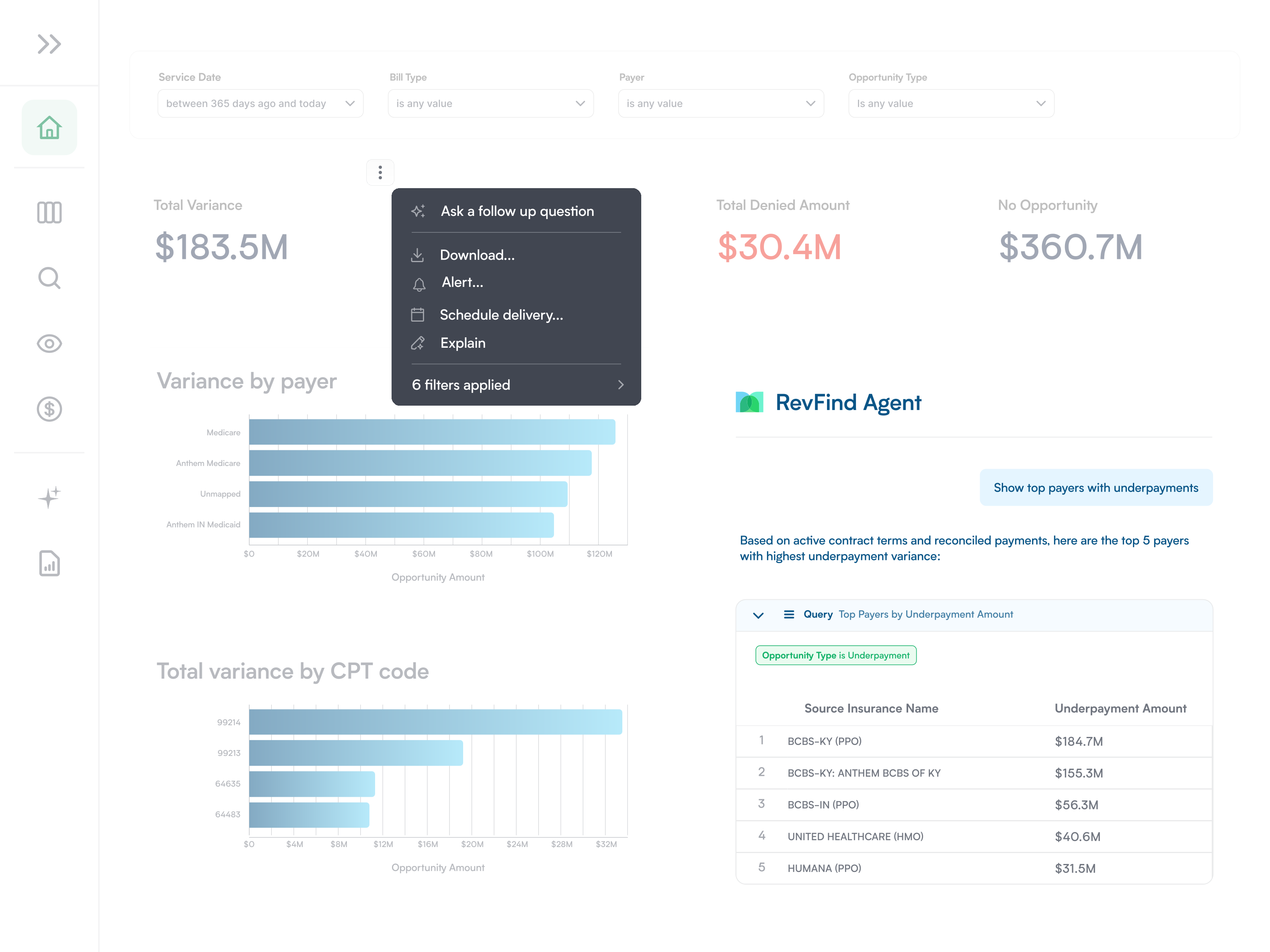
Validate revenue opportunities faster with AI-powered analytics
Turn payment variances into actionable insights without manual analysis. RevFind Agent helps your team validate what’s recoverable, quantify the opportunity, and understand what’s driving it.
.png)
Verify the contract terms behind every expected rate
Turn your payer contracts into answers with AI that tracks down the right terms, interprets complex payer language, and ties it all back to your numbers.
Make recovery work easier to manage and collaborate on
Keep recovery efforts organized in one place. Assign ownership, collaborate across teams, and track progress so everyone knows what’s being worked and what’s been recovered.
%20(1).png)
Revenue Recovery Services
Maximize payer reimbursement by augmenting our underpayment and denial management software with our proven revenue recovery experts.
RevFind FAQs
RevFind is MD Clarity’s AI-powered denial and underpayment detection and contract optimization platform. It is built expressly for provider organizations to maximize reimbursements, improve contract terms, and automate tedious staff tasks. It integrates contract data, claim activity, and recovery workflows into one intelligent platform, so you can recover underpaid claims, fix root causes of denials, and model contract proposal scenarios without manual spreadsheets or disconnected tools.
RevFind detects underpayments and denials by analyzing 837 claims and 835 remittance data, calculating the expected allowable for each charge based on your contract terms and payer reimbursement rules, and comparing it to what was actually allowed or paid. It surfaces high-value and recurring variances, identifies trends, and provides line-level detail so teams can quickly validate and act on recovery opportunities.
RevFind’s agentic AI helps teams turn complex revenue data into clear, actionable insights faster. AI analytics surface patterns and anomalies across underpayments and denials, while natural-language queries let teams get answers grounded in their data and contract terms, build visualizations, and forecast trends. This helps teams uncover what’s driving revenue leakage, prioritize where to focus, and take action on the highest-value opportunities.
Yes. RevFind is built to connect seamlessly with the systems you already use. It is an integration-agnostic platform that connects with various practice management systems, clearinghouses, and data warehouses to power its workflows.
- Unified data hub – MD Clarity pulls patient and financial data from all your source systems into one platform, giving you a single view of the revenue cycle.
- Multiple integration methods – The platform supports HL7, FHIR APIs, X12 EDI 835/837, flat-file transfers, and direct connections to reporting servers or data warehouses, ensuring connectivity with your existing systems
- Pre-built connectors – Out-of-the-box integrations exist for most major practice management solutions, minimizing setup time and IT effort.
Its integrations include ModMed, athenahealth, NexGen, eClinicalWorks, Compulink, Nextech, Experity, and more.
Yes. With RevFind’s built-in modeling engine, you can run “what-if” scenarios to understand the net revenue impact of proposed payer changes before negotiations start. You can also model scenarios using your preferred variables to help shape and support your counterproposal.
RevFind also surfaces underpayment and denial patterns at the charge level. During validation, your team can apply root cause labels to recurring trends, track their financial impact over time, and bring that evidence into future negotiations. This gives you a clearer view of where revenue is being lost and which rates, terms, or reimbursement issues are most important to address.
Most electronic health record (EHR) and practice management (PM) platforms were built for clinical documentation, scheduling, and claims submission—not the deep financial analytics and workflow automation required to monitor payer behavior.
Contract intelligence functionality of EHRs and PM systems remains limited, if it exists at all. Many systems do not have contract management capabilities in any capacity. For those that do, fee schedules are stored as static tables with no logic for escalators, carve-outs, “lesser-of” clauses, or other reimbursement methodology intricacies. Without the ability to precisely model expected reimbursement, other systems fail to deliver meaningful value.
Other systems typically lack additional workflows that bridge the gap between insights and real business results, including:
- Automatically routing underpaid claims to staff worklists
- Drilling down to identify root causes of underpayments and denials
- Monitoring key contract terms such as renewal dates
- Modeling the net revenue impact of contract scenarios
- Auditing expected reimbursement calculations
- Preparing appeal packages
- Tracking appeal resolution progress
Dedicated contract management and recovery platforms such as RevFind model even the most complex payer agreements with exact precision to calculate expected reimbursements with optimal accuracy. They then manage the complete workflow from payment variance detection through to appeal, root cause fix, or contract negotiation. These tools routinely uncover the hidden net revenue that generic EHR or PM modules miss, and drive increased net revenue by facilitating the complete revenue optimization workflow.
Provider organizations can see meaningful financial impact within the first few months of using RevFind. Published MD Clarity customer results include:
- An orthopedic MSO identified $10.3M in underpayments.
- Radiology Imaging Associates validated $1.1M in underpayments.
- Community Care Partners recovered $160K from a single CPT code within three months, followed by another $80K in subsequent recoveries.
Beyond individual recoveries, RevFind helps teams identify recurring underpayment and denial patterns so they can address the root causes of revenue leakage over time.
Get paid in full by bringing clarity to your revenue cycle
The latest insights on underpayment detection from MD Clarity
.png)
Healthcare Underpayments: A Guide for Providers

Healthcare Contract Management Platform: How Automation Beats An Internal Contract Manager

Payer Contract Modeling: How Providers Model Changes To Negotiate Better Reimbursement Rates