
.avif)
.svg)
Concord and MD Clarity's PayerMonitor share more positioning DNA than most contract software comparisons: both are modern AI-native platforms with transparent published pricing, fast deployment, and customer-friendly accessibility designed to keep contracts out of expensive enterprise sales cycles. But they were built for fundamentally different problems.
Concord is a general-purpose contract lifecycle management (CLM) platform serving SMB and mid-market businesses across industries - popular with companies that want to handle the full contract lifecycle (drafting, negotiation, eSignature, post-signature tracking) without legal complexity. PayerMonitor is a healthcare-purpose-built contract management platform focused specifically on payer agreements and reimbursement enforcement.
If your contract problem is "we need a modern, easy-to-use platform for our sales agreements, NDAs, and vendor contracts," Concord is a strong choice. If your contract problem is specifically "we have payer agreements with hidden underpayments and reimbursement terms buried in 200-page PDFs," PayerMonitor was built for exactly that.
TL;DR - The Quick Verdict
- Choose Concord if you need a full-lifecycle CLM for general business contracts - drafting, negotiation, unlimited eSignature, post-signature tracking - with transparent pricing and a 1-day to weeks deployment timeline.
- Choose MD Clarity PayerMonitor if your priority is payer contract management - extracting reimbursement terms, catching underpayments, supporting renegotiations - with healthcare-purpose-built AI and connections to revenue cycle workflows.
- They serve different buyers and different jobs. Concord sits with sales operations, legal ops, and procurement leaders managing routine business contracts. PayerMonitor sits with revenue cycle, managed care, and finance leadership managing payer agreements.
At-a-Glance Comparison
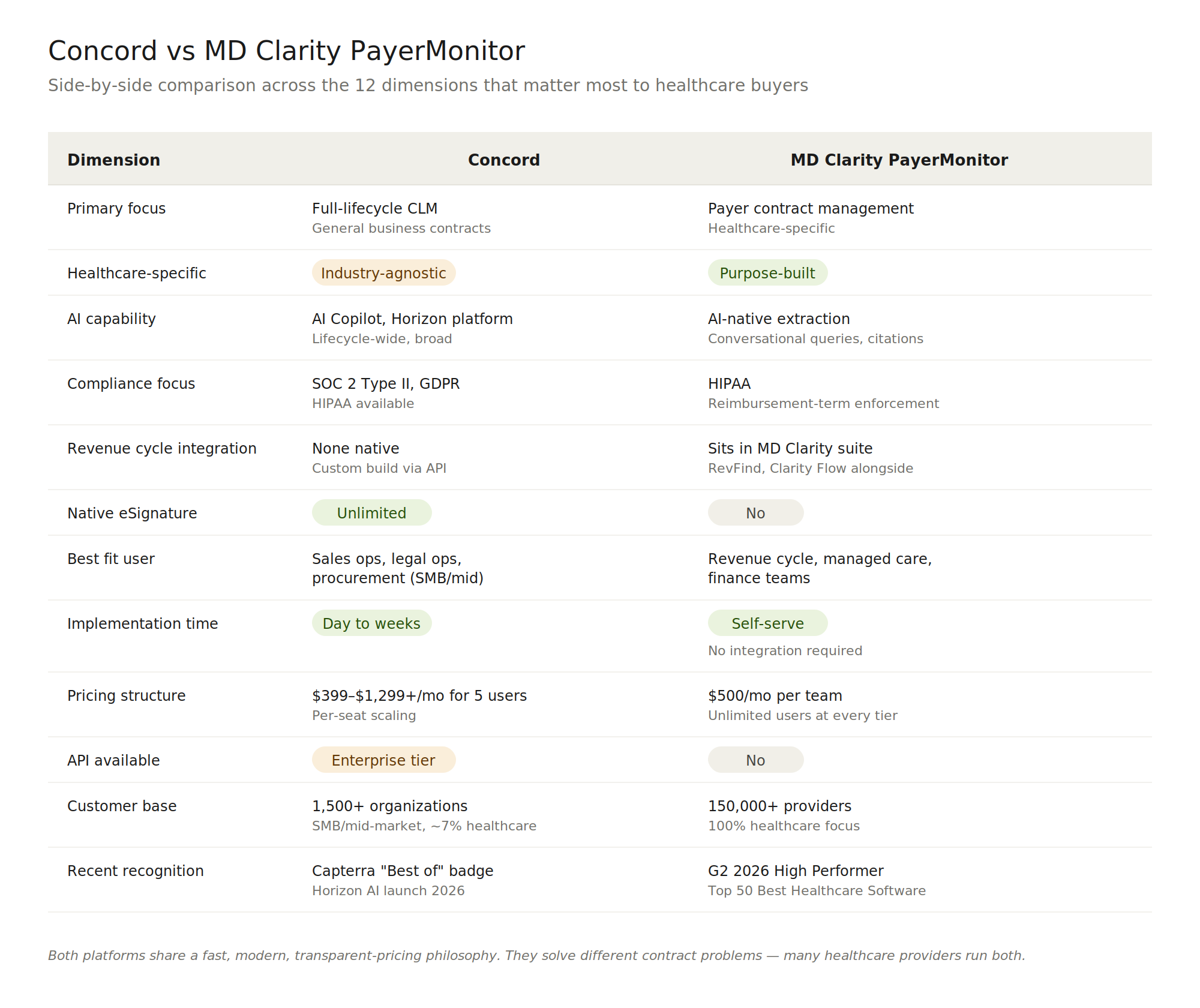
What Concord Does Well
Concord was founded in 2014 with a clear thesis that has held up well: most contracts are routine business transactions that don't need legal intervention. The platform is designed for the 70% of agreements (Concord's own number) that businesses can self-serve through templates, automated workflows, and AI assistance - leaving legal to focus on the high-stakes contracts that actually need them. Concord serves 1,500+ SMB and mid-market organizations (typically 50–1,000 employees) and has built a strong reputation among sales operations, legal ops, and procurement teams.
The platform recently launched Horizon, described as an AI-first conversational platform where users manage the entire contract lifecycle by asking questions rather than navigating software - a meaningful evolution from traditional CLM UX.
Where Concord is strongest:
- Full-lifecycle CLM in one platform. Concord handles intake, drafting, negotiation (with a Google Docs–style editor), redlining, eSignature, and post-signature tracking - all in a single workspace. For organizations whose contract problem spans the full lifecycle, this end-to-end coverage is a real strength.
- Unlimited eSignature on every plan. Unlike DocuSign or other platforms that charge per envelope, Concord includes unlimited eSignatures with no per-document fees. Legally binding and compliant with ESIGN and eIDAS.
- AI Copilot and Horizon. Concord's AI handles contract review (claimed to deliver review in 23 seconds), clause extraction, deadline alerts, and executive-ready reporting. The new Horizon platform extends this with conversational AI for natural-language contract management.
- Transparent published pricing. Concord publishes its tiers: Essentials at $399/month for 5 users, Business at $699/month for 5 users, and Enterprise custom-quoted. Additional users at $39–$54/month each on the lower tiers. No mystery enterprise pricing process.
- Fast deployment. Most teams are live in 1 day for basic configurations, with Concord claiming customers reduce contract cycles by 75% on average.
- Self-serve for non-legal teams. Designed so sales, procurement, and operations users can self-serve standard agreements with legal-approved templates and AI guidance, freeing legal teams to focus on complex contracts.
- Solid integrations. Native connectors for Salesforce, HubSpot, Google Drive, Dropbox, Box, Microsoft 365, and Zapier. Open API on the Enterprise tier.
- Strong security baseline. SOC 2 Type II certified and GDPR compliant, with role-based permissions, encryption, and regular audits. HIPAA compliance available (typically on higher tiers).
- Multi-entity support. Subsidiary management for organizations with multiple business entities - separate branding, user permissions, and contract templates per entity.
Where Concord's gaps show up for healthcare:
- Not healthcare-specific. Concord is a general-purpose CLM that serves multiple industries. According to GetApp data, only 7% of Concord's review base comes from healthcare - meaningful but well below industries like IT and Computer Software. The platform doesn't include healthcare-specific contract types, payer agreement templates, Stark/AKS compliance workflows, or exclusion list integration.
- No payer reimbursement focus. Concord doesn't extract structured payer reimbursement terms (DRGs, lesser-of, stop-loss, escalators, timely filing limits), benchmark them across payers, model rate scenarios, or feed contract terms into underpayment detection. That's outside the platform's design.
- Per-seat pricing scales unfavorably for healthcare. Concord's pricing is built around 5-user packs with $39–$54 per additional user, which works well for a sales team of 8–15 but adds up quickly when contract access spans multiple healthcare departments (clinical, finance, supply chain, compliance, managed care). At 50 users, Concord's effective cost can exceed PayerMonitor's tiered per-team pricing significantly.
- Reviewers note AI depth limits. Independent third-party analysis flags that Concord's AI is solid for general use but doesn't reach the depth of platforms like Ironclad or specialized AI platforms - described as "minimal" advanced AI for risk analysis and smart clause extraction. The Horizon launch is a meaningful evolution that may close some of this gap going forward.
- Workflow customization has limits. Concord's workflow builder handles standard approval routing well but isn't as deep as Ironclad's or Agiloft's no-code engines for complex multi-entity structures with deeply nested approval hierarchies.
- Best fit is general business operations. Concord's product, support model, and customer base center on sales, procurement, and operations leaders. Revenue cycle and managed care leaders evaluating it for payer contract management will find unfamiliar territory.
What MD Clarity PayerMonitor Does Well
PayerMonitor takes a fundamentally different approach. Rather than serving the full contract lifecycle across all contract types, it goes deep on the most financially material contracts in healthcare: payer agreements. A single managed care contract can be worth hundreds of millions of dollars in revenue, yet most provider organizations still manage payer contracts in spreadsheets, shared drives, or in a generalist CLM that treats them like every other document.
Where PayerMonitor is strongest:
- Healthcare-purpose-built. PayerMonitor was designed from the ground up for healthcare reimbursement. The AI is trained on the language hospitals actually contend with - DRGs, carve-outs, lesser-of provisions, stop-loss, escalators, timely filing limits - and recognizes how different payers phrase the same term.
- Citation traceability. Every extracted term and AI-generated answer is linked to a snippet in the source contract. When a managed care director is preparing for a renegotiation, or a billing team is fighting a denial, they can verify the source instantly.
- Self-serve onboarding. PayerMonitor requires no system integration to deliver value. Teams sign up, upload contracts, and the AI begins extracting structured terms immediately. Like Concord, the platform shares a fast-deployment philosophy - but the AI work happening behind the scenes is purpose-built for payer contracts.
- Conversational AI with citations. Staff can ask plain-language questions about contracts and get answers backed by source citations, without scrolling through 200-page PDFs.
- MD Clarity suite integration. PayerMonitor sits within MD Clarity's broader revenue platform alongside RevFind (underpayment detection, denial management, contract modeling) and Clarity Flow (patient estimates) - providing a unified contract foundation that informs reimbursement enforcement.
- Unlimited users at every tier. PayerMonitor publishes its pricing publicly: Starter at $500/month per team, Professional at $1,850/month, custom Enterprise - all with unlimited users and the full AI feature set. For organizations where contract access spans many departments, this is meaningfully different from per-seat pricing.
- Third-party recognition. G2 named MD Clarity to its 2026 Best Software Awards on the Top 50 Best Healthcare Software Products list - one of only two revenue cycle platforms - alongside High Performer recognition in G2's Grid for revenue cycle management.
Where PayerMonitor's gaps show up:
- Not a full-lifecycle CLM. PayerMonitor isn't built for contract drafting, redlining, or eSignature workflows. If your contract problem includes generating new contracts from templates, negotiating with counterparties, or executing signatures, that's Concord's territory, not PayerMonitor's.
- Not designed for general business contracts. PayerMonitor is purpose-built for payer agreements, not NDAs, sales contracts, vendor agreements, or HR paperwork.
- No external API at this time. PayerMonitor is a standalone product designed for self-serve use; there's no API for custom integrations beyond the MD Clarity suite.
- Best fit is revenue cycle and managed care. Sales operations or legal ops teams shopping for "a modern CLM for our routine business contracts" are not the typical PayerMonitor buyer.
Side-by-Side: Feature Comparison
Contract centralization and search
Both platforms centralize contracts in searchable repositories with version control. Concord's strength is breadth - covering every contract type across the business with unlimited document storage and a Google Docs–style editor. PayerMonitor's strength is depth on payer agreements specifically - every payer contract is structured the same way, with reimbursement terms automatically extracted into comparable fields. A managed care director can compare timely filing limits across five payers in a single view, without writing custom queries.
AI capabilities
Both platforms invest heavily in AI, but on different strategies. Concord's AI Copilot and the recently-launched Horizon platform handle contract drafting, review, clause extraction, and natural-language portfolio queries across all contract types. PayerMonitor's AI is purpose-trained on healthcare reimbursement language. It extracts structured payer contract terms with citation-traceable outputs, supports natural-language queries, and is tuned to recognize how different payers express the same reimbursement concept. Concord's AI is broader; PayerMonitor's AI is deeper for the payer use case. Both vendors are evolving their AI rapidly, with Concord's Horizon launch and MD Clarity's continued investment in healthcare-specific extraction models.
Pre-signature workflows (drafting, negotiation, eSignature)
This is one of Concord's clearest single advantages over PayerMonitor - and it reflects fundamentally different product scopes. Concord handles the full pre-signature lifecycle: contract intake, template-based drafting, in-browser redlining and negotiation, approval workflows, and unlimited native eSignature. For organizations whose primary contract pain is execution velocity, Concord covers that workflow end-to-end. PayerMonitor doesn't include any of this - payer contracts are typically already executed by the time they enter PayerMonitor for management and reimbursement enforcement.
Compliance
Concord is SOC 2 Type II certified and GDPR compliant, with HIPAA compliance available for healthcare deployments. The platform's compliance posture is strong for general business and broad regulatory frameworks. PayerMonitor focuses on HIPAA and reimbursement-term enforcement out of the box. Neither platform is the right answer if your primary compliance question is around Stark/AKS provider relationships - that's better served by a healthcare-purpose-built compliance CLM like symplr or Ntracts. Concord is best when compliance is one of many contract concerns; PayerMonitor is best when reimbursement enforcement is the priority.
Revenue cycle integration
This is the largest functional gap between the two platforms. Concord has no native revenue cycle integration - it's not designed to feed contract terms into claim-level systems, underpayment detection, or denial management. Customers wanting this connection would need to build it via Concord's API (Enterprise tier). PayerMonitor sits within MD Clarity's broader revenue platform alongside RevFind for underpayment detection, denial management, and contract modeling. Payer contracts in PayerMonitor flow into operational revenue tools without integration effort.
Implementation and time-to-value
Both platforms are designed for fast deployment - and either can typically be live in days to weeks. Concord claims 1-day deployment for basic configurations, with more complex setups taking a few weeks. PayerMonitor takes a similarly self-serve approach: teams subscribe, log in, and upload contracts, with AI extraction beginning immediately. The two platforms share a "fast, no IT project required" deployment philosophy that meaningfully separates them from enterprise CLMs.
Pricing
This is one of the most concrete differences between the two platforms - and where their fundamentally different pricing models matter most.
Concord's published pricing scales per-seat:
- Essentials - $399/month for 5 users (~$80/user/month effective rate); additional users $39/month
- Business - $699/month for 5 users (~$140/user/month effective rate); additional users $54/month
- Enterprise - custom pricing with API access and advanced features
For a 5-user team at the Essentials tier, Concord costs $399/month. For a 50-user team across multiple departments at the Business tier, the cost climbs to roughly $3,000–$4,000/month.
MD Clarity publishes PayerMonitor pricing publicly with a fundamentally different structure - per-team rather than per-seat:
- Starter - $500/month per team (25 documents, 50 questions/month, unlimited users)
- Professional - $1,850/month per team (150 documents, 250 questions/month, unlimited users, priority support)
- Enterprise - custom pricing for larger health systems
The pricing models reflect different product scopes and customer profiles. Concord's per-seat model fits a sales team of 8–15 users efficiently. PayerMonitor's per-team model with unlimited users fits healthcare organizations where contract access spans multiple departments without per-user licensing pain.
Customer experience
Both platforms invest heavily in customer success and modern UX. Concord serves 1,500+ organizations across industries with strong reviews on ease of use and customer support. MD Clarity's growth from a single product (RevFind) into a multi-product revenue platform now serving 150,000+ providers reflects strong customer expansion patterns within healthcare. Both vendors compete on accessibility and support, not enterprise complexity.
Use Case Decision Framework
Three questions will narrow your shortlist faster than any feature comparison.
Pick Concord if you can answer "yes" to most of these:
- Your contract problem is full-lifecycle (drafting, negotiating, signing, tracking) for general business contracts
- You need unlimited eSignature without per-document fees
- Sales, legal, or procurement leadership owns the buying decision
- Your team is in the 5–50 user range typical for SMB/mid-market deployments
- You want a modern AI-assisted CLM with transparent pricing
- You're not specifically focused on payer reimbursement workflows
Pick MD Clarity PayerMonitor if you can answer "yes" to most of these:
- Your most pressing contract problem is payer reimbursement and revenue leakage
- You want a healthcare-purpose-built platform with AI trained on reimbursement language
- You need structured payer contract terms (not just searchable text) for renegotiations and underpayment work
- You want contract data that connects to revenue cycle workflows
- Revenue cycle, managed care, or finance leadership owns the buying decision
- Contract access spans multiple departments and per-seat pricing is a problem
- Your payer contracts are already executed (signing isn't the contract problem you're solving)
Use both if:
- You're a healthcare organization that needs both jobs done - Concord for the full lifecycle of general business contracts (NDAs, vendor agreements, employment, partnerships) AND PayerMonitor for the payer contracts that drive revenue
- Different teams own different contract types: legal/operations owns the general portfolio with Concord; revenue cycle owns payer contracts with PayerMonitor
- The combined cost is still less than a single enterprise CLM and matches the actual workflow split
This is a logical pattern for healthcare organizations large enough to support both buying centers. Concord and PayerMonitor solve different parts of contract operations - and many provider organizations would benefit from both.
Customer Profile: Who Buys What
Concord customers are SMB and mid-market businesses (typically 50–1,000 employees) across industries - IT services, professional services, financial services, real estate, construction, and healthcare among them. According to GetApp data, healthcare represents about 7% of Concord's review base. The unifying characteristic is an organization that wants modern CLM without enterprise complexity, where sales operations, legal ops, or procurement leads contract operations.
MD Clarity customers range from small specialty groups and ASCs at the Starter tier through large hospitals, physician groups, and IDNs at the Professional and Enterprise tiers. The common thread is a sophisticated revenue cycle or managed care function that views payer contracts as financial instruments - not just legal documents. MD Clarity now serves more than 150,000 providers nationwide, and its tiered pricing model makes it accessible to a much broader range of provider organizations than enterprise CLMs typically reach.
Frequently Asked Questions
Are Concord and MD Clarity PayerMonitor direct competitors?
Not really. Both are modern AI-native platforms with transparent pricing and fast deployment, but they solve different contract problems. Concord is a full-lifecycle CLM for general business contracts (drafting, negotiating, signing, tracking). PayerMonitor is healthcare-purpose-built for managing already-executed payer agreements with reimbursement enforcement. Many healthcare organizations would benefit from both.
Can Concord handle payer contracts?
Yes - Concord can store payer contracts like any other document, with AI Copilot for general extraction and search. What it doesn't do is extract structured reimbursement terms (DRGs, lesser-of, carve-outs, stop-loss, escalators), benchmark them across payers, model rate scenarios, or feed them into underpayment detection. Those are revenue cycle capabilities that require purpose-built tooling.
Can MD Clarity PayerMonitor replace Concord?
For payer contract management, yes - and more deeply, because PayerMonitor was purpose-built for that use case. For an organization that also needs full-lifecycle CLM (drafting, negotiation, eSignature) for NDAs, sales agreements, vendor contracts, employment paperwork, and other contract types, PayerMonitor isn't designed to replace that broader scope.
Which platform deploys faster?
Both are designed for fast deployment. Concord claims 1-day deployment for basic configurations, with more complex setups taking weeks. PayerMonitor is similarly self-serve - teams subscribe, upload contracts, and AI extraction begins immediately. Both meaningfully separate themselves from enterprise CLMs that take months.
Which platform has better AI?
They're optimized for different jobs. Concord's AI Copilot and Horizon platform handle drafting, review, clause extraction, and natural-language queries across all contract types - useful for general business CLM. PayerMonitor's AI is purpose-trained on healthcare reimbursement language with citation-traceable outputs and structured term extraction. Concord's AI is broader; PayerMonitor's is deeper for the healthcare payer use case.
How much do they cost?
Concord's published pricing: Essentials at $399/month for 5 users (additional users $39/month), Business at $699/month for 5 users (additional users $54/month), Enterprise custom. Per-seat pricing scales with team size. PayerMonitor publishes its pricing: Starter at $500/month per team, Professional at $1,850/month, custom Enterprise - all with unlimited users at every tier. The pricing models suit different team structures.
Do they integrate with my EHR or other systems?
Concord offers integrations with Salesforce, HubSpot, Google Drive, Dropbox, Box, Microsoft 365, and Zapier, plus an open API on the Enterprise tier. PayerMonitor is intentionally standalone with no external API at this time. For organizations using MD Clarity's broader revenue platform (RevFind, Clarity Flow), PayerMonitor sits naturally alongside those products. Claim-level integration with billing systems is handled by other modules of the MD Clarity platform.
Is one HIPAA-compliant and the other not?
Both can be HIPAA-compliant. Concord is SOC 2 Type II certified and GDPR compliant by default, with HIPAA compliance available (typically on higher tiers). PayerMonitor is HIPAA-compliant by default, designed for healthcare from the ground up.
Does either platform offer a free trial?
Both offer demos rather than self-service free trials. Concord provides product walkthroughs and pricing breakdowns through their sales team. PayerMonitor offers demos on request.
The Bottom Line
If you're trying to pick between Concord and MD Clarity PayerMonitor, the honest framing is that they're not really substitutes. They share a deployment philosophy (fast, transparent pricing, modern AI-native UX) but they were designed for fundamentally different contract problems.
Concord is one of the strongest modern CLMs on the market for SMB and mid-market businesses that need full-lifecycle contract management - drafting, negotiation, eSignature, and post-signature tracking - across general business contracts. The AI Copilot, Horizon platform, and unlimited eSignature make it a natural choice for sales-driven, procurement-heavy, or operations-led contract teams.
PayerMonitor is healthcare-purpose-built contract management focused on the contract type that drives provider revenue: payer agreements. If you want a platform engineered specifically for payer contracts, with healthcare-purpose-trained AI, citation-traceable outputs, and direct connections to revenue cycle workflows that catch underpayments and inform negotiations - PayerMonitor was built for that exact problem.
For many provider organizations, both jobs need doing. The combined cost is typically less than a single enterprise CLM, and the resulting workflow - Concord for the general contract portfolio plus PayerMonitor for payer contracts - matches how healthcare organizations actually operate.
Ready to see PayerMonitor in action? Request a demo from MD Clarity to see how AI-native payer contract management can turn your agreements into recovered revenue.
Get paid in full by bringing clarity to your revenue cycle
Related Posts


Subscribe to the

Healthcare Clarified newsletter
Get the latest insights on RCM and healthcare policy in your inbox
