
DocuSign CLM vs MD Clarity PayerMonitor: A Healthcare Contract Management Software Comparison
.avif)
.svg)
DocuSign CLM and MD Clarity's PayerMonitor sit on different ends of the contract software market - and they're built for different parts of the contract lifecycle. DocuSign CLM is the contract lifecycle management extension of one of the world's most recognized eSignature brands, with deep enterprise integrations and AI-assisted workflows for the full contract lifecycle. PayerMonitor is a healthcare-purpose-built contract management platform focused specifically on payer agreements and reimbursement enforcement.
If your contract problem looks like sending NDAs and sales agreements out for signature, tracking obligations across hundreds of contract types, and integrating tightly with Salesforce, DocuSign CLM is a natural fit. If your contract problem looks like managing payer agreements with hidden underpayments and reimbursement terms buried in 200-page PDFs, PayerMonitor was built for exactly that.
This guide breaks down where each platform wins, how they compare across the dimensions that matter to healthcare buyers, and how to decide which one fits.
TL;DR - The Quick Verdict
- Choose DocuSign CLM if you're already standardized on DocuSign for eSignature and want to extend into the full contract lifecycle, with strong Salesforce integration and a familiar user experience for legal and procurement teams.
- Choose MD Clarity PayerMonitor if your priority is payer contract management - extracting reimbursement terms, catching underpayments, supporting renegotiations - with healthcare-purpose-built AI, self-serve onboarding, and transparent published pricing.
- Many healthcare organizations run both. DocuSign for general signature and contract lifecycle workflows; PayerMonitor for the financially material payer contracts that drive provider revenue. They solve different problems.
At-a-Glance Comparison
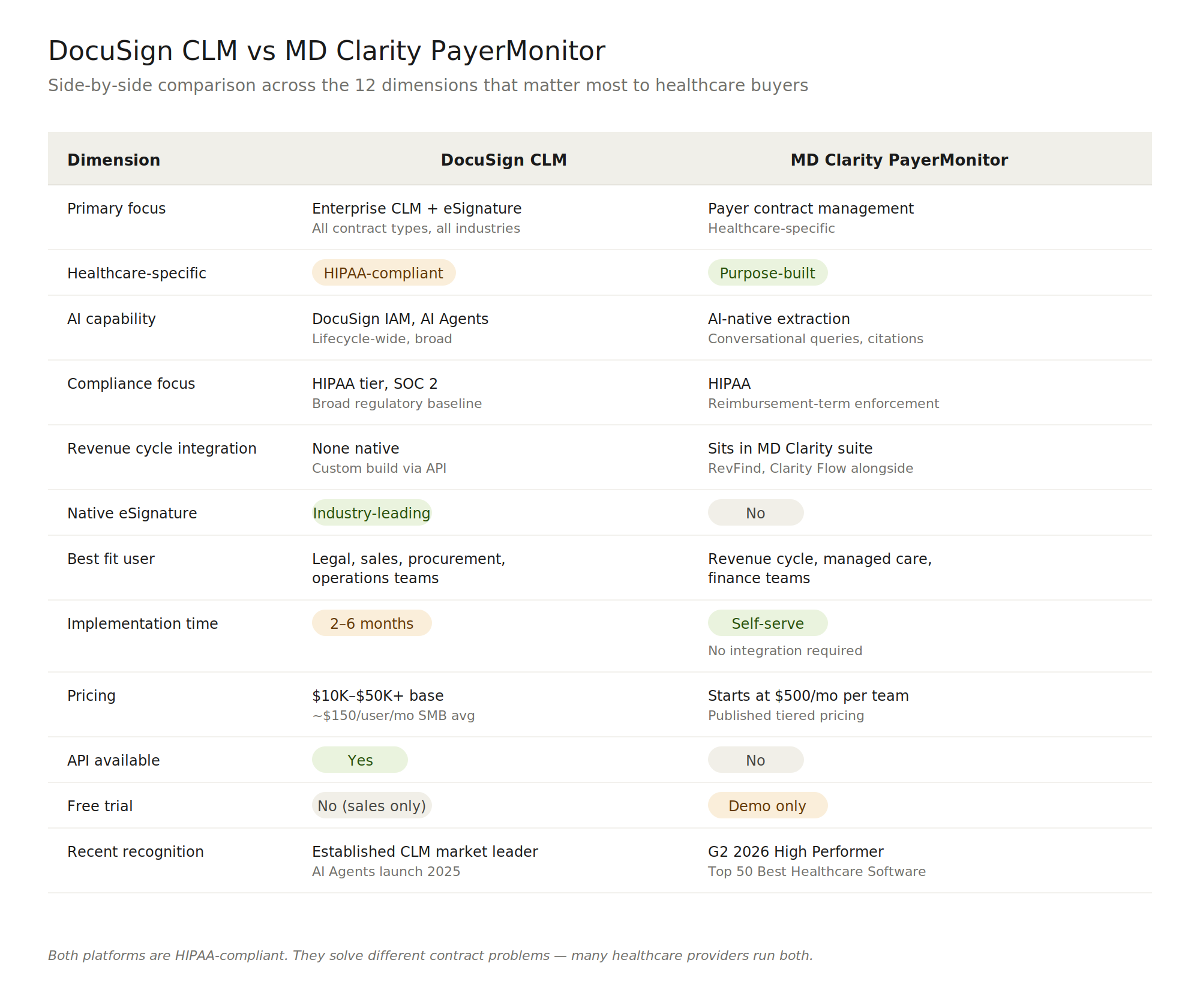
What DocuSign CLM Does Well
DocuSign CLM (formerly SpringCM, acquired by DocuSign in 2018) extends the company's category-defining eSignature platform into full contract lifecycle management - covering authoring, negotiation, approval workflows, obligation tracking, and renewal management. The platform's biggest strength is brand familiarity: DocuSign is already deployed at hundreds of thousands of organizations for eSignature, and CLM is the natural extension when contract operations grow beyond signing.
Where DocuSign CLM is strongest:
- Industry-leading eSignature. DocuSign has been the dominant eSignature platform for over a decade, with the largest installed base of any signing tool. CLM inherits that signature engine natively, eliminating the need for a separate eSignature subscription.
- Salesforce integration. DocuSign CLM has particularly strong Salesforce integration, with the ability to merge Salesforce data into contracts, generate agreements directly from Opportunities, and centralize negotiation, redlining, and version control inside Salesforce.
- AI capabilities. DocuSign IAM (Intelligent Agreement Management) and the recently launched AI Agents handle automatic term extraction, contract summarization, predictive analytics, and obligation tracking. AI features integrate across the contract lifecycle, not as standalone tools.
- Workflow automation. A drag-and-drop workflow editor with over 100 pre-configured steps lets teams design contract workflows for generation, approval, signing, storage, and management without coding.
- Enterprise integrations. Native connections to Salesforce, NetSuite, SAP Ariba, Microsoft, and dozens of other business platforms - with a broad API for custom builds.
- Brand familiarity. Many organizations already have DocuSign procurement, security review, and user adoption infrastructure in place - meaningful hidden value for new product rollouts.
- HIPAA-compliant tier available. DocuSign offers a dedicated HIPAA-compliant pricing tier for healthcare organizations, alongside SOC 2 and broader regulatory certifications.
Where DocuSign CLM's gaps show up for healthcare:
- Not healthcare-specific. DocuSign CLM is a horizontal CLM that serves financial services, healthcare, government, and other regulated industries. It's HIPAA-compliant from a security standpoint, but it doesn't include healthcare-specific contract types, payer agreement templates, Stark/AKS compliance workflows, or exclusion list integration.
- No payer reimbursement focus. DocuSign CLM doesn't extract structured payer reimbursement terms (DRGs, lesser-of, stop-loss, escalators, timely filing limits), benchmark them across payers, model rate scenarios, or feed contract terms into underpayment detection. That's outside the platform's scope.
- Pricing scales unfavorably. Base licensing typically runs $10,000 to $50,000+ per year, with SMB buyers reporting an average cost of $150 per user per month. For healthcare organizations where contract access spans multiple departments - clinical, finance, supply chain, compliance, managed care - per-seat pricing adds up fast.
- Hidden costs are real. Industry analysis suggests total spend often doubles over three years once implementation ($200–$350/hour through DocuSign Professional Services), Salesforce/SAP integration setup ($5K–$30K), envelope overages, training, and 5–8% annual price escalators are factored in. A $75,000 base license can become $150,000–$200,000 in actual annual spend.
- No free trial for CLM. Unlike DocuSign eSignature (which has a 30-day free trial), DocuSign CLM is sales-only - meaning longer evaluation cycles and limited ability to validate fit before committing.
- Reported learning curve. User reviews on G2 and Capterra consistently flag a steeper learning curve and the occasional confusion between DocuSign CLM and DocuSign eSignature, with reviewers noting that toggling between contract stages and tracking edits "can feel unintuitive until your team builds familiarity."
- Best fit is legal and sales operations. DocuSign CLM's core deployment patterns assume legal, sales, or procurement leadership as the primary buyer. Revenue cycle and managed care leaders evaluating it for payer contract management will find it unfamiliar territory.
What MD Clarity PayerMonitor Does Well
PayerMonitor takes a fundamentally different approach. Rather than serving every contract need across an organization, it goes deep on the most financially material contracts in healthcare: payer agreements. A single managed care contract can be worth hundreds of millions of dollars in revenue, yet most provider organizations still manage payer contracts in spreadsheets, shared drives, or in a generalist CLM that treats them like every other document.
Where PayerMonitor is strongest:
- Healthcare-purpose-built. PayerMonitor was designed from the ground up for healthcare reimbursement. The AI is trained on the language hospitals actually contend with - DRGs, carve-outs, lesser-of provisions, stop-loss, escalators, timely filing limits - and recognizes how different payers phrase the same term.
- Citation traceability. Every extracted term and AI-generated answer is linked to a snippet in the source contract. When a managed care director is preparing for a renegotiation, or a billing team is fighting a denial, they can verify the source instantly.
- Self-serve onboarding. PayerMonitor requires no system integration to deliver value. Teams sign up, upload contracts, and the AI begins extracting structured terms immediately. There's no IT project, no professional services engagement, no months-long workflow build.
- Conversational AI with citations. Staff can ask plain-language questions about contracts and get answers backed by source citations, without scrolling through 200-page PDFs.
- MD Clarity suite integration. PayerMonitor sits within MD Clarity's broader revenue platform alongside RevFind (underpayment detection, denial management, contract modeling) and Clarity Flow (patient estimates) - providing a unified contract foundation that informs reimbursement enforcement.
- Published, predictable pricing. PayerMonitor publishes its pricing publicly: Starter at $500/month per team, Professional at $1,850/month, custom Enterprise. Every tier includes the full AI feature set and unlimited users - no per-seat pricing, no hidden integration fees, no annual escalators surprising you in year three.
- Third-party recognition. G2 named MD Clarity to its 2026 Best Software Awards on the Top 50 Best Healthcare Software Products list - one of only two revenue cycle platforms - alongside High Performer recognition in G2's Grid for revenue cycle management.
Where PayerMonitor's gaps show up:
- Not a full-portfolio CLM. PayerMonitor isn't built to manage NDAs, vendor contracts, sales agreements, employment paperwork, or any of the dozens of contract types DocuSign CLM handles natively. If your business needs one platform to govern every contract type from sales to procurement to HR, PayerMonitor isn't designed for that scope.
- No native eSignature. PayerMonitor is a contract management platform for executed payer agreements - signature workflows aren't part of the product. (Most healthcare organizations using PayerMonitor still use DocuSign or a similar tool for eSignature.)
- No external API at this time. PayerMonitor is a standalone product designed for self-serve use; there's no API for custom integrations beyond the MD Clarity suite.
- Less workflow customization. PayerMonitor is a focused product, not a configuration platform. If your organization needs to model an entirely custom contract intake workflow with conditional logic across many contract types, DocuSign CLM offers more flexibility.
- Best fit is revenue cycle and managed care. Legal-driven shopping processes that prioritize signature operations and Salesforce-integrated contract creation will find PayerMonitor's positioning unfamiliar.
Side-by-Side: Feature Comparison
Contract centralization and search
Both platforms centralize contracts in searchable repositories with version control. DocuSign CLM's strength is breadth - managing every contract type across an enterprise, with strong document repository capabilities, advanced search, and Salesforce integration that surfaces contract data inside CRM workflows. PayerMonitor's strength is depth on payer agreements specifically - every payer contract is structured the same way, with reimbursement terms automatically extracted into comparable fields. A managed care director can compare timely filing limits across five payers in a single view, without writing custom queries.
AI capabilities
Both platforms invest in AI, but on different strategies. DocuSign IAM (Intelligent Agreement Management) and AI Agents handle term extraction, summarization, and predictive analytics across the full contract lifecycle - useful for any organization processing high contract volume. PayerMonitor's AI is purpose-trained on healthcare reimbursement language. It extracts structured payer contract terms with citation-traceable outputs, supports natural-language queries, and is tuned to recognize how different payers express the same reimbursement concept. DocuSign CLM's AI is broader; PayerMonitor's AI is deeper for the payer use case.
eSignature and execution
This is DocuSign CLM's clearest single advantage over PayerMonitor - DocuSign defined the eSignature category and CLM inherits that engine natively. For organizations whose primary contract pain is execution velocity (NDAs, sales agreements, employment contracts moving through signature), DocuSign CLM is purpose-built for that workflow. PayerMonitor doesn't include eSignature because it's not the use case - payer contracts are typically already executed by the time they enter PayerMonitor for management and reimbursement enforcement.
Compliance
DocuSign CLM offers a HIPAA-compliant tier alongside SOC 2 and broader regulatory certifications, making it suitable for healthcare from a security standpoint. Specific compliance workflows for healthcare (Stark, AKS, exclusion list monitoring, COI tracking) need to be built using DocuSign's workflow designer or sourced separately. PayerMonitor focuses on HIPAA and reimbursement-term enforcement out of the box. Neither platform is the right answer if your primary compliance question is around Stark/AKS provider relationships - that's better served by a healthcare-purpose-built compliance CLM like symplr or Ntracts. DocuSign CLM is best when compliance is one of many contract concerns; PayerMonitor is best when reimbursement enforcement is the priority.
Revenue cycle integration
This is one of the largest functional gaps between the two platforms. DocuSign CLM has no native revenue cycle integration - it's not designed to feed contract terms into claim-level systems, underpayment detection, or denial management. Customers who want this connection have to build it via API. PayerMonitor sits within MD Clarity's broader revenue platform alongside RevFind for underpayment detection, denial management, and contract modeling. Payer contracts in PayerMonitor flow into operational revenue tools without integration effort.
Implementation and time-to-value
DocuSign CLM implementations vary significantly based on scope and integrations - typical deployments take 2–6 months when accounting for workflow design, Salesforce or SAP integration, training, and rollout. Implementation is billed separately at $200–$350/hour through DocuSign Professional Services, with mid-market deployments commonly $5,000–$15,000 in setup costs alone. PayerMonitor takes a fundamentally different approach: self-serve onboarding with no integration required. Teams subscribe, upload contracts, and AI extraction begins immediately - no IT project, no professional services engagement.
Pricing
DocuSign CLM uses custom enterprise pricing with no published tiers. Base licensing typically runs $10,000–$50,000+ annually, with SMB buyers reporting average per-user costs of $150/month - well above typical SMB budget ranges. The total cost story is more important than the base license: industry analysis suggests three-year total spend often doubles when implementation, integrations, envelope overages, training, and 5–8% annual price escalators are factored in. A $75,000 base license can become $150,000–$200,000 in actual annual spend by year three.
MD Clarity publishes PayerMonitor pricing publicly:
- Starter - $500/month per team (25 documents, 50 questions/month, unlimited users)
- Professional - $1,850/month per team (150 documents, 250 questions/month, unlimited users, priority support)
- Enterprise - custom pricing for larger health systems with high contract volume
Every tier includes the full AI feature set and unlimited users. The pricing models are fundamentally different: DocuSign CLM is enterprise software priced per seat with substantial hidden costs; PayerMonitor is contract-volume-based SaaS with transparent published rates and unlimited users.
Use Case Decision Framework
Three questions will narrow your shortlist faster than any feature comparison.
Pick DocuSign CLM if you can answer "yes" to most of these:
- You're already standardized on DocuSign for eSignature and want to extend into the full contract lifecycle
- You need a CLM that handles all contract types - sales, NDAs, procurement, employment, partnerships
- Salesforce-integrated contract creation is a priority
- Legal, sales operations, or procurement leadership owns the buying decision
- You have $50K+ annual budget and the IT capacity to support a 2–6 month implementation
- Contract execution velocity (signing) is one of your top contract pain points
Pick MD Clarity PayerMonitor if you can answer "yes" to most of these:
- Your most pressing contract problem is payer reimbursement and revenue leakage
- You want a healthcare-purpose-built platform, not a horizontal CLM with HIPAA certification
- You need to be live immediately - self-serve onboarding, no IT or legal ops project required
- You want transparent, published pricing without per-seat sprawl or hidden integration fees
- Revenue cycle, managed care, or finance leadership owns the buying decision
- Your payer contracts are already executed (signing isn't the contract problem you're solving)
Use both if:
- You're a healthcare organization that needs both jobs done - DocuSign for eSignature and full contract lifecycle workflows across the enterprise; PayerMonitor for the specific payer contracts that drive revenue
- Your existing DocuSign deployment handles non-payer contract operations well, but isn't extracting reimbursement terms or connecting to revenue cycle workflows
- Different teams own different contract problems: legal owns the lifecycle and signature operations; revenue cycle owns payer contract management
This is one of the more common "use both" patterns in healthcare. Many provider organizations are already DocuSign customers and don't want to displace that infrastructure - but they also have a payer contract management gap that DocuSign CLM doesn't fill. PayerMonitor is the natural complement.
Customer Profile: Who Buys What
DocuSign CLM customers span industries - financial services, healthcare, government, technology, and beyond - with the platform especially popular among organizations that already use DocuSign eSignature. The unifying characteristic is a mature legal or sales operations function that views contracting as a workflow problem to be automated, with budget for enterprise software and IT capacity to support a 2–6 month rollout. DocuSign CLM holds a meaningful share of the CLM market and is one of the most established platforms in the category.
MD Clarity customers range from small specialty groups and ASCs at the Starter tier through large hospitals and health systems, physician groups, and IDNs at the Professional and Enterprise tiers. The common thread is a sophisticated revenue cycle or managed care function that views payer contracts as financial instruments - not just legal documents. MD Clarity now serves more than 150,000 providers nationwide, and its tiered pricing model makes it accessible to a much broader range of provider organizations than enterprise CLMs typically reach.
Frequently Asked Questions
Are DocuSign CLM and MD Clarity PayerMonitor direct competitors?
Not really. DocuSign CLM is a horizontal CLM extending from eSignature into the full contract lifecycle. PayerMonitor is a healthcare-purpose-built contract management platform focused specifically on payer agreements. Many provider organizations use DocuSign for general contract workflows and PayerMonitor for payer contract management.
Can DocuSign CLM handle healthcare contracts?
Yes - DocuSign CLM offers a HIPAA-compliant tier and can store and manage any healthcare contract document. What it doesn't include are healthcare-specific contract templates, Stark/AKS compliance workflows, exclusion list integration, or payer reimbursement-term extraction. Those need to be built using DocuSign's workflow designer or sourced from another tool.
Can MD Clarity PayerMonitor replace DocuSign CLM?
For payer contract management, yes - and more deeply, because PayerMonitor was purpose-built for that use case. For an organization that also needs eSignature, full contract lifecycle workflows across NDAs, sales agreements, employment paperwork, and other contract types, PayerMonitor isn't designed to replace that broader scope. Most organizations adopting PayerMonitor keep DocuSign for eSignature.
Which platform deploys faster?
PayerMonitor, by a significant margin. It's a self-serve platform with no integration requirement - teams sign up, upload contracts, and the AI starts extracting structured terms immediately. DocuSign CLM implementations typically take 2–6 months, with implementation fees of $200–$350/hour through DocuSign Professional Services adding $5,000–$15,000+ in setup costs.
Which platform has better AI?
They're optimized for different scopes. DocuSign IAM and AI Agents are broad - covering term extraction, summarization, predictive analytics, and obligation tracking across all contract types. PayerMonitor's AI is purpose-trained on healthcare reimbursement language with citation-traceable outputs and structured term extraction tuned to payer contracts. The "better" AI depends on which job you're trying to do.
How much do they cost?
DocuSign CLM uses custom pricing with base licensing typically $10,000–$50,000+ annually. SMB buyers report average per-user costs of $150/month. Total three-year spend often doubles once implementation, Salesforce integration ($5K–$30K), envelope overages, training, and 5–8% annual price escalators are factored in. PayerMonitor publishes its pricing: Starter at $500/month per team, Professional at $1,850/month, custom Enterprise - every tier with unlimited users, full AI feature set, and no implementation fees.
Do they integrate with my EHR or other systems?
DocuSign CLM offers extensive integration with Salesforce, Microsoft, NetSuite, SAP Ariba, and dozens of business platforms via a native API. PayerMonitor is intentionally standalone with no external API at this time. For organizations using MD Clarity's broader revenue platform (RevFind, Clarity Flow), PayerMonitor sits naturally alongside those products. Claim-level integration with billing systems is handled by other modules of the MD Clarity platform.
Is one HIPAA-compliant and the other not?
Both are HIPAA-compliant. DocuSign offers a dedicated HIPAA-compliant pricing tier alongside SOC 2 and broader regulatory certifications.
Does either platform offer a free trial?
DocuSign CLM does not offer a free trial - evaluation requires going through sales. (Note: DocuSign eSignature, a separate product, does offer a 30-day free trial.) PayerMonitor offers demos on request rather than a self-service free trial.
The Bottom Line
If you're trying to pick between DocuSign CLM and MD Clarity PayerMonitor, the honest framing is that they're not really substitutes. They were designed for different contract problems.
DocuSign CLM is a strong choice for organizations that need a full-lifecycle CLM with industry-leading eSignature, deep Salesforce integration, and AI assistance across many contract types. If you're already a DocuSign customer and have the budget for enterprise software, DocuSign CLM is the natural extension.
PayerMonitor is healthcare-purpose-built contract management focused on the contract type that drives provider revenue: payer agreements. If you want a platform engineered specifically for payer contracts, with healthcare-purpose-trained AI, citation-traceable outputs, transparent published pricing, and direct connections to revenue cycle workflows that catch underpayments and inform negotiations - PayerMonitor was built for that exact problem.
For most provider organizations, payer contracts are the largest financial lever in the business. A single underpaid contract clause can leak millions of dollars per year - invisible without the right tooling. That's the gap PayerMonitor was built to close, with a price point and deployment model far more accessible than enterprise CLM platforms.
Ready to see PayerMonitor in action? Request a demo from MD Clarity to see how AI-native payer contract management can turn your agreements into recovered revenue.
Get paid in full by bringing clarity to your revenue cycle
Related Posts

Subscribe to the

Healthcare Clarified newsletter
Get the latest insights on RCM and healthcare policy in your inbox
