
.avif)
.svg)
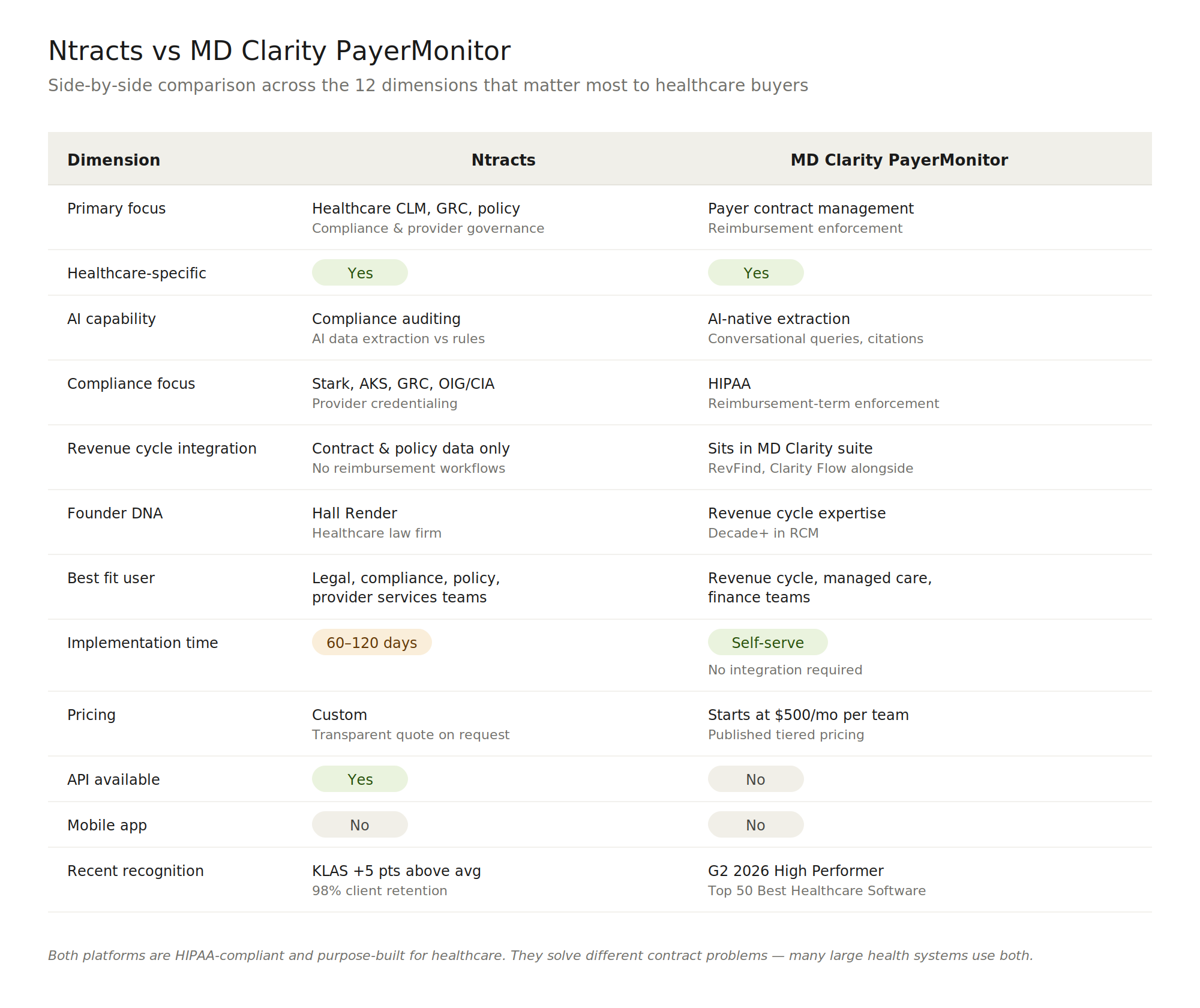
Ntracts and MD Clarity's PayerMonitor are both purpose-built for healthcare - but they're built for very different jobs. Ntracts is a 30-year-old healthcare CLM rooted in the legal expertise of Hall Render, focused on contract lifecycle management, governance, risk and compliance (GRC), and policy management. PayerMonitor is an AI-native platform focused specifically on payer contract management and reimbursement enforcement.
This guide breaks down where each platform wins, how they compare across the dimensions buyers actually evaluate, and how to decide which one fits your needs. If your biggest contract risk is regulatory compliance and provider governance, Ntracts is likely the answer. If your biggest exposure is payer reimbursement and revenue leakage, PayerMonitor was built for exactly that.
TL;DR - The Quick Verdict
- Choose Ntracts if you need a comprehensive healthcare CLM that handles the full lifecycle of every contract type - provider, vendor, BAA, employment - alongside policy management and Stark/AKS compliance workflows.
- Choose MD Clarity PayerMonitor if your top contract problem is payer agreements: extracting reimbursement terms, catching underpayments, and turning contracts into actionable operational data.
- Choose both if you're a large health system where compliance/legal owns contract governance and revenue cycle/managed care owns payer contract management. Different buying centers, different jobs to be done, both critical.
At-a-Glance Comparison
What Ntracts Does Well
Ntracts was originally built out of Hall Render, one of the country's leading healthcare law firms - and that legal DNA is reflected in everything the platform does. Ntracts has provided healthcare contract management for more than 30 years, and it now spans three pillars: contract lifecycle management, governance/risk/compliance (GRC), and policy management (the latter via the MCN Solutions Ellucid platform).
Where Ntracts is strongest:
- Compliance depth. Workflows are built around healthcare regulatory standards - Stark Law, the Anti-Kickback Statute, OIG corporate integrity agreements (CIAs), and similar. The platform has supported real CIA enforcement deployments, including HealthNet's successful 5-year CIA using Ntracts as its CLM system.
- Provider services workflows. Strong fit for hospitals and physician groups managing provider onboarding, credentialing, and compensation tracking - areas where generic CLMs typically fall short.
- Policy management. Ntracts Policy Manager (formerly MCN Solutions Ellucid) handles policy creation, version control, attestation, and integration with a library of 15,000+ healthcare policy templates.
- AI-enabled compliance auditing. Ntracts uses AI to audit contract data against specific regulatory rules - improving accuracy and surfacing compliance gaps before they become findings.
- Customer support. Ntracts exceeded the national software average by 5+ points in KLAS Research, with US-based healthcare experts as customer points of contact and a reported 98% client retention rate.
- Implementation track record. The vendor cites a 100% implementation success rate and 3× faster time-to-value than agnostic CLMs.
Where Ntracts' gaps show up:
- No reimbursement enforcement. Ntracts manages contracts; it doesn't extract structured payer reimbursement terms (DRGs, lesser-of, stop-loss, escalators), benchmark them across payers, model rate scenarios, or feed terms into underpayment detection. That's outside its scope.
- No mobile app. Ntracts does not currently offer a mobile app, per public listings.
- English/US-focused. Designed for the US healthcare market specifically, which is great for US providers but limits international applicability.
- Best fit is legal/compliance/policy. Revenue cycle and managed care teams are not the typical buyer.
What MD Clarity PayerMonitor Does Well
PayerMonitor takes a fundamentally different approach. Rather than managing every contract type across the enterprise, it goes deep on the most financially material contracts in healthcare: payer agreements. A single managed care contract can be worth hundreds of millions of dollars in revenue, yet most organizations still manage payer contracts in spreadsheets or shared drives. PayerMonitor exists to fix that.
Where PayerMonitor is strongest:
- Reimbursement-term extraction. The AI is trained on the language hospitals actually contend with - DRGs, carve-outs, lesser-of provisions, stop-loss, escalators, timely filing limits - and recognizes how different payers phrase the same term. Payer contracts become structured operational data, not document images.
- Citation traceability. Every extracted term and AI-generated answer is linked to a snippet in the source contract. When a managed care director is preparing for a renegotiation, or a billing team is fighting a denial, they can verify the source instantly.
- Self-serve onboarding. PayerMonitor requires no system integration to deliver value. Teams can sign up, upload contracts, and start using AI extraction immediately. There's no IT project, no professional services engagement.
- Conversational AI with citations. Staff can ask plain-language questions about their contracts and get answers backed by source citations, without scrolling through 200-page PDFs.
- MD Clarity suite integration. PayerMonitor sits within MD Clarity's broader revenue optimization platform alongside RevFind (underpayment detection, denial management, contract modeling) and Clarity Flow (patient estimates) - providing a unified contract foundation that informs reimbursement enforcement.
- Published pricing. PayerMonitor publishes its pricing - Starter at $500/month per team, Professional at $1,850/month, custom Enterprise - making procurement and budgeting substantially easier.
- Third-party recognition. G2 named MD Clarity to its 2026 Best Software Awards on the Top 50 Best Healthcare Software Products list - one of only two revenue cycle platforms - alongside High Performer recognition in G2's Grid for revenue cycle management.
Where PayerMonitor's gaps show up:
- Not a full-portfolio CLM. PayerMonitor isn't built to manage vendor contracts, BAAs, supply chain agreements, provider compensation contracts, or organizational policies. If you need one system to govern every contract in your organization, PayerMonitor is not that system.
- Not designed for Stark/AKS workflows. While HIPAA-compliant and built to enterprise security standards, PayerMonitor isn't designed around the COI tracking, gift logs, exclusion list monitoring, or policy management workflows that Ntracts handles natively.
- No external API at this time. PayerMonitor is a standalone product designed for self-serve use; teams interact with it directly rather than wiring it into other systems via API.
Side-by-Side: Feature Comparison
Contract centralization and search
Both platforms centralize contracts in a searchable repository with version control and audit trails. Ntracts' strength is breadth - supporting every contract type across the enterprise, with a "Related Contracts" function that surfaces how independent agreements (Master, BAA, Lease, Employment) relate to one another. PayerMonitor's strength is depth - every payer contract is structured the same way, with reimbursement terms automatically extracted into comparable fields, so a managed care director can compare timely filing limits across five payers in a single view.
AI capabilities
Both platforms use AI, but for different jobs. Ntracts' AI focuses on data extraction and compliance auditing - surfacing whether contract data conforms to specific regulatory rules (e.g., Stark thresholds, FMV benchmarks) and improving accuracy of contract metadata. PayerMonitor's AI is purpose-trained on reimbursement language. It extracts structured terms from payer agreements with citation-traceable outputs, supports natural-language queries, and recognizes how different payers phrase the same term. Ntracts' AI accelerates compliance review. PayerMonitor's AI accelerates revenue cycle decisions.
Compliance
Ntracts is the clear leader for regulatory contract compliance. The platform was built around Stark Law, AKS, and OIG enforcement workflows - and has real customer evidence supporting CIA-level scrutiny, including HealthNet's 5-year CIA. PayerMonitor focuses on HIPAA, secure architecture, and reimbursement enforcement. If the compliance question keeping you up at night is "are we exposing ourselves to Stark or AKS violations through provider relationships?" - that's Ntracts' territory. If it's "are we collecting what our payer contracts entitle us to?" - that's PayerMonitor's.
Provider services and policy management
This is a Ntracts strength PayerMonitor doesn't address. Ntracts handles provider onboarding, credentialing, compensation management, and policy lifecycle (creation, version control, attestation) - areas core to running a hospital's compliance function. Through the integrated MCN Solutions Ellucid platform, organizations get access to thousands of expert-reviewed healthcare policy templates. PayerMonitor doesn't operate in this space at all.
Revenue cycle integration
This is the biggest functional gap in the other direction. Ntracts manages contract documents and policy data, with healthcare IT integrations focused on automating data exchange across systems involved in the contract lifecycle. PayerMonitor sits within MD Clarity's broader revenue platform - RevFind for underpayment detection, denial management, and contract modeling, and Clarity Flow for patient estimates. For revenue cycle, managed care, and finance teams, contract terms in PayerMonitor flow into operational revenue tools. Ntracts isn't built for this; PayerMonitor is.
Implementation and time-to-value
Both vendors emphasize fast implementation, but the meaning differs. Ntracts cites 100% implementation success and 3× faster time-to-value than agnostic CLMs - typically 60–120 days for full deployment depending on scope, data migration, and integrations. PayerMonitor takes a fundamentally different approach: self-serve onboarding with no integration required. Teams subscribe, upload contracts, and the AI begins extracting structured terms immediately. There's no IT project. The trade-off is scope: Ntracts' longer timeline reflects the breadth of its enterprise rollout; PayerMonitor's instant onboarding reflects its narrower, deeper focus.
Pricing
Ntracts uses transparent custom pricing on request, typical of healthcare-specific enterprise CLMs - scaled to organization size, modules, and contract volume.
MD Clarity publishes PayerMonitor pricing publicly:
- Starter - $500/month per team (25 documents, 50 questions/month, unlimited users)
- Professional - $1,850/month per team (150 documents, 250 questions/month, unlimited users, priority support)
- Enterprise - custom pricing for larger health systems with high contract volume
Every PayerMonitor tier includes the full AI feature set and unlimited users. That structure makes PayerMonitor accessible to single-specialty groups and ASCs at the Starter level - a price point well below typical enterprise CLMs.
Security and certifications
Both platforms are HIPAA-compliant and built to enterprise security standards. Ntracts emphasizes data security and audit-readiness as core to its compliance positioning. PayerMonitor's security architecture meets HIPAA and enterprise requirements, with vendor due diligence handled via standard SOC and security questionnaires.
Use Case Decision Framework
Three questions will narrow your shortlist faster than any feature comparison.
Pick Ntracts if you can answer "yes" to most of these:
- Your biggest contract risk is regulatory compliance (Stark, AKS, OIG/CIA exposure)
- You need to manage every contract type across the enterprise - provider, vendor, BAA, employment, supply chain
- Provider services workflows (onboarding, credentialing, compensation) are core to your operations
- Policy management is part of your contracting function
- Legal, compliance, or HR leadership owns the buying decision
- You have the budget and timeline for a 60–120 day enterprise implementation
Pick MD Clarity PayerMonitor if you can answer "yes" to most of these:
- Your biggest contract risk is payer reimbursement and revenue leakage
- You're managing payer agreements in spreadsheets, shared drives, or a generic system
- You want contract terms to drive operational outcomes - catching underpayments, supporting appeals, modeling rate negotiations
- Revenue cycle, managed care, or finance leadership owns the buying decision
- You need to be live immediately - self-serve onboarding, no IT project
- You want a platform that grows into broader revenue optimization (denial management, recovery)
Use both if:
- You're a large health system or IDN with mature compliance and revenue cycle operations
- You have differentiated buying centers (legal/compliance owns CLM and policy; managed care/finance owns payer contract management)
- The annual contract value at risk on either dimension justifies dedicated tooling
This is a common pattern. Sophisticated provider organizations don't expect a single platform to be excellent at both regulatory compliance contracting and payer reimbursement management - those are different jobs done by different teams with different success metrics.
Customer Profile: Who Buys What
Ntracts customers include health systems, hospitals, physician groups, FQHCs, and payers - frequently those with mature compliance functions, OIG agreements in their history (or actively in a CIA), or strong legal/compliance leadership owning the contract function. Public case studies include BJC HealthCare and HealthNet, and the platform's Hall Render origin makes it a natural choice for organizations who view contracting through a regulatory lens first.
MD Clarity customers range from large health systems and hospitals to small physician groups, ASCs, and management services organizations (MSOs). The common thread is a sophisticated revenue cycle or managed care function that views payer contracts as financial instruments - not just legal documents. MD Clarity now serves more than 150,000 providers nationwide, and its broader platform appeals to organizations that want contract management connected directly to claim-level revenue recovery.
Frequently Asked Questions
Are Ntracts and MD Clarity PayerMonitor direct competitors?
Not really. They overlap on contract centralization, but their core jobs differ. Ntracts is a healthcare CLM built around compliance, policy, and provider governance. PayerMonitor is a specialized payer contract management platform tied to reimbursement enforcement. Many large health systems use both.
Can MD Clarity PayerMonitor replace Ntracts?
Not for vendor, BAA, provider compensation, or policy management. PayerMonitor is purpose-built for payer agreements and the reimbursement workflows attached to them. If your biggest contract problem is payer reimbursement, PayerMonitor solves it deeply. If you need to govern every contract type and manage policies from one system, Ntracts is the broader fit.
Can Ntracts handle payer contracts?
Yes - payer agreements can be stored and tracked in Ntracts like any other contract. What Ntracts doesn't do is extract structured reimbursement terms (DRGs, lesser-of, carve-outs, stop-loss, escalators), benchmark them across payers, model rate scenarios, or feed them into underpayment detection. Those are revenue cycle capabilities that require purpose-built tooling.
Which platform deploys faster?
PayerMonitor, by a wide margin. It's a self-serve platform with no integration requirement - teams sign up, upload contracts, and the AI starts working immediately. Ntracts cites 100% implementation success and 3× faster time-to-value than agnostic CLMs, but that still typically means 60–120 days for an enterprise rollout including data migration and configuration.
Which platform has better AI?
They're optimized for different things. Ntracts' AI focuses on data extraction and compliance auditing - surfacing whether contracts conform to regulatory rules. PayerMonitor's AI is purpose-trained on reimbursement language with citation-traceable outputs and structured term extraction, plus conversational queries. The "better" AI depends on which job you're trying to do.
How much do they cost?
Ntracts uses custom pricing and offers transparent quotes on request, scaled to organization size and modules. PayerMonitor publishes its pricing: Starter at $500/month per team, Professional at $1,850/month, and custom Enterprise - all tiers include unlimited users and the full AI feature set. Request quotes from both for an apples-to-apples comparison against your specific scope.
Do they integrate with my EHR or other systems?
Ntracts is designed for integration within the healthcare IT ecosystem and offers an API. PayerMonitor is intentionally standalone - there's no external API at this time and no EHR/ERP integration required to use it. For organizations already using MD Clarity's broader revenue platform (RevFind, Clarity Flow), PayerMonitor sits naturally alongside those products. Claim-level integration with your billing system is handled by other modules of the MD Clarity platform.
Is one HIPAA-compliant and the other not?
Both are HIPAA-compliant and built for healthcare. The differences are in what they're optimized to do, not in baseline security or compliance posture.
The Bottom Line
If you're trying to pick between Ntracts and MD Clarity PayerMonitor, the honest framing is that you're not really picking between them - you're picking between two contract problems and deciding which one is costing you more.
If the answer is regulatory compliance, provider governance, or policy management, Ntracts is the right tool. Its three-decade healthcare focus, Hall Render legal heritage, and CIA-tested compliance workflows make it the strongest specialized CLM for compliance-led contract operations.
If the answer is payer reimbursement, underpayments, or revenue leakage on managed care agreements, PayerMonitor was built for that problem and connects directly into the revenue cycle workflows that close the loop. For most provider organizations, the bigger financial lever is payer contracts - a single underpaid contract clause can leak millions of dollars per year, and unlike compliance fines, that leakage is invisible without the right tooling.
Ready to see PayerMonitor in action? Request a demo from MD Clarity to see how AI-native payer contract management can turn your agreements into recovered revenue.
Get paid in full by bringing clarity to your revenue cycle
Related Posts


Subscribe to the

Healthcare Clarified newsletter
Get the latest insights on RCM and healthcare policy in your inbox
