
.avif)
.svg)
Choosing between Waystar Patient Estimation and MD Clarity's Clarity Flow usually comes down to one question: do you want a patient estimator inside a broader end-to-end revenue cycle suite, or do you want a purpose-built patient estimate platform?
This guide compares the two head-to-head across the dimensions that actually drive ROI - estimate accuracy, automation depth, No Surprises Act compliance, patient payment capture, integration approach, implementation speed, pricing, and reporting - and gives a clear recommendation for each buyer profile.
TL;DR: Which is better, Waystar Patient Estimation or Clarity Flow?
Waystar Patient Estimation is the stronger choice for organizations already standardized on Waystar for claims, eligibility, and the broader revenue cycle. Its estimator is one module inside an end-to-end RCM platform, and the value compounds when you use the rest of the suite.
Clarity Flow is the stronger choice for organizations that want a dedicated, automation-first patient estimate platform with built-in upfront payment capture and minimal staff effort. It was purpose-built for patient cost estimation, runs on a charge-level pricing engine that simulates payer adjudication logic, auto-delivers estimates with embedded payment links, and pairs with RevFind for downstream underpayment recovery - all on the same auditable calculation engine.
Both platforms generate accurate estimates, support Good Faith Estimates under the No Surprises Act, and offer connected patient payment workflows. The right answer depends less on raw feature parity and more on whether you want a unified RCM stack or a focused estimate engine.
What is Waystar Patient Estimation?
Waystar Patient Estimation is the patient estimate module inside Waystar's broader revenue cycle platform. It uses enriched benefits data, EDI, and robotic process automation to calculate patient liability without manual lookups, supports out-of-network estimation, and delivers plain-language estimates connected to Waystar's payment tools.
Waystar is one of the largest revenue cycle vendors in the U.S., and the estimator integrates natively with the rest of its stack - eligibility verification, propensity-to-pay analytics, denials, claims, and patient payments. The value is highest for organizations using multiple Waystar modules.
What is MD Clarity's Clarity Flow?
Clarity Flow takes the top spot in patient estimate software because it was purpose-built for patient cost estimation rather than retrofitted from a clearinghouse or general RCM suite. That focus shows up most clearly in MD Clarity's underlying pricing engine - a charge-level claim adjudication simulator that factors in modifiers, locality adjustments (including GPCI), bundled services, multiple-procedure reductions, and the lesser-of clauses that quietly break simpler estimators. Total allowed amounts are calculated from the most granular charge-level detail upward - the same way payers actually adjudicate.
That precision drives the rest of the workflow. Clarity Flow auto-delivers estimates by HIPAA-secure email, text, or letter using rule-based workflows with no staff clicks - MD Clarity reports this touchless approach reduces manual estimate work by 95% or more. Each estimate carries a pay-now link, includes required No Surprises Act language, and is fully auditable down to the charge. Clarity Flow is built for health systems, ambulatory surgical centers, MSOs, and growing physician groups, and pairs with RevFind - MD Clarity's revenue optimization platform that runs on the same pricing engine and surfaces underpayments, denials, and contract mismatches.
At-a-glance comparison
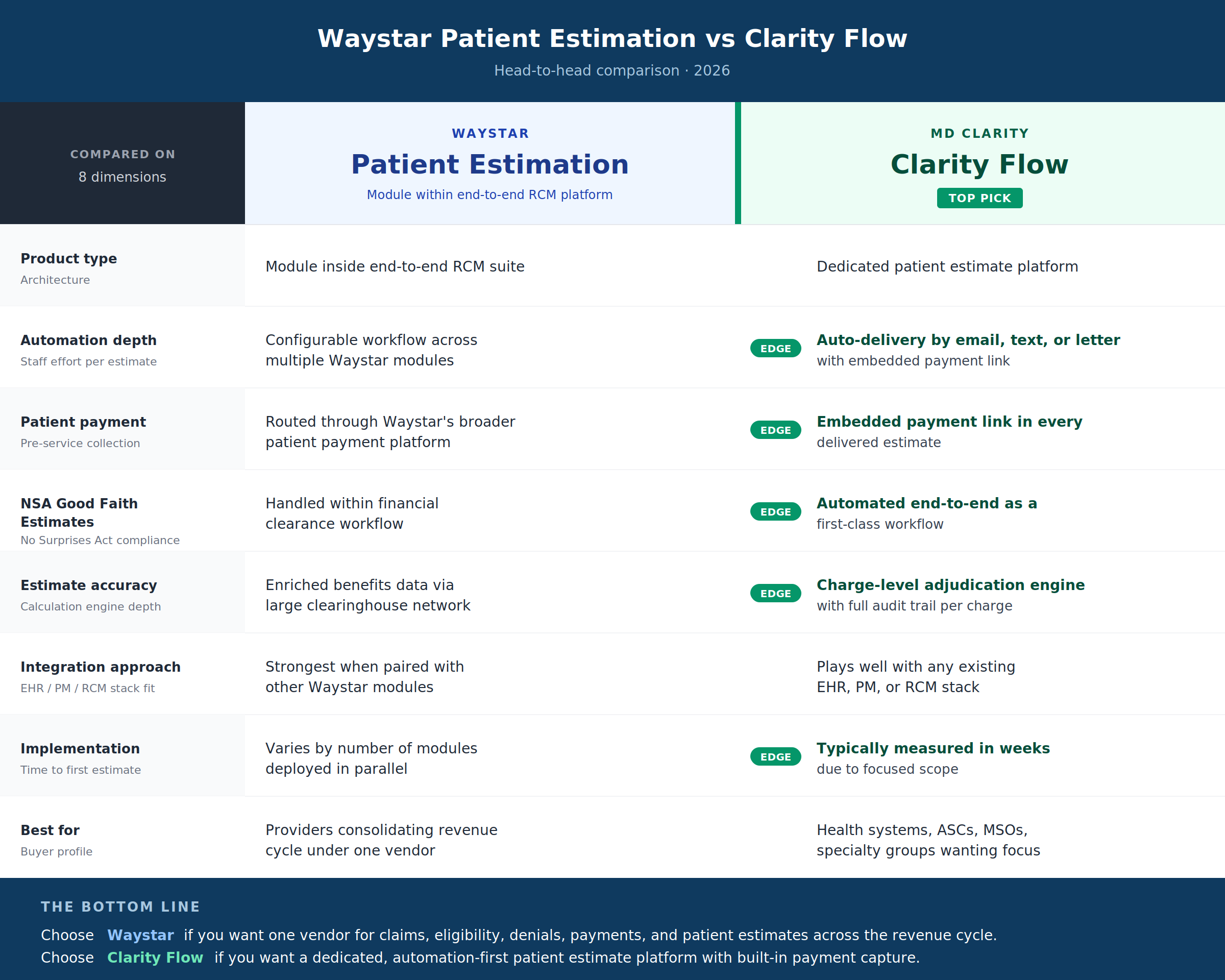
A quick summary of where each platform sits:
- Product type. Waystar Patient Estimation is a module inside an end-to-end RCM suite. Clarity Flow is a dedicated patient estimate platform built on a charge-level claim adjudication pricing engine.
- Primary buyer. Waystar targets providers who want one vendor for the full revenue cycle. Clarity Flow targets health systems, ASCs, MSOs, and specialty groups that want focused patient financial software.
- Estimate delivery. Waystar provides plain-language estimates through its connected patient communication tools. Clarity Flow auto-delivers estimates by email, text, or letter - MD Clarity reports a 95%+ reduction in manual estimate work.
- Upfront payment. Waystar payments run through its broader patient payment platform. Clarity Flow embeds a secure payment link directly in the estimate.
- NSA Good Faith Estimates. Both support GFEs. Waystar's GFE workflow lives within its financial clearance stack; Clarity Flow automates the workflow end-to-end with built-in timelines, disclaimers, and audit trails.
- Adjacent capabilities. Waystar pairs with eligibility, claims, denials, and the rest of its RCM suite. Clarity Flow pairs with RevFind for underpayment detection and contract analytics, all running on the same pricing engine.
- Best fit. Waystar if you want a single-vendor RCM platform. Clarity Flow if you want a best-of-breed estimate engine.
Head-to-head comparison
1. Estimate accuracy
The two platforms approach accuracy from different starting points.
Waystar Patient Estimation uses enriched benefits data, EDI, and RPA to pull liability without manual lookups, drawing on Waystar's broader claims and eligibility data network. Estimates are strong, particularly for organizations already running eligibility through Waystar.
Clarity Flow is built on a charge-level pricing engine that simulates payer claim adjudication systems with the same logic payers use - modifiers, GPCI adjustments, sequestration, bundled services, contractual policies, multiple-procedure reductions, and lesser-of clauses are all factored into each estimate. Total allowed amounts are calculated from charge-level detail upward, and every estimate is fully auditable down to each individual charge.
Edge: Clarity Flow for organizations that want adjudication-mirroring depth and full charge-level auditability. Waystar's broader data graph is an advantage in complex multi-payer environments.
2. Automation depth
This is where the two platforms diverge most.
Waystar Patient Estimation automates the calculation step and integrates with Waystar's patient communication and payment tools. The full workflow is configurable, but the stack is broader, and getting end-to-end automation typically requires combining several Waystar modules.
Clarity Flow is built around the principle that estimates should be automated end-to-end: benefit verification runs in the background, the estimate is generated, and it's delivered to the patient by HIPAA-secure email, text, or letter using rule-based workflows - typically without any staff clicks. Patients can pay directly from the estimate. MD Clarity reports the touchless approach reduces manual estimate work by 95% or more compared to benefit lookups and spreadsheet workflows. Exception-based tracking flags estimates with missing or conflicting source data and routes them to staff worklists, so people only touch estimates that actually need a person.
Edge: Clarity Flow. If reducing staff effort per estimate is the primary goal, the dedicated platform wins.
3. No Surprises Act compliance and Good Faith Estimates
Both platforms generate Good Faith Estimates required for self-pay and uninsured patients under the No Surprises Act. Producing GFEs manually with spreadsheets is time-consuming and creates audit risk, which is why most providers automate the workflow.
Waystar handles GFEs as part of its financial clearance and patient access workflow, often paired with its eligibility and authorization tools.
Clarity Flow automates GFE compliance as a first-class feature, with built-in timelines, required disclaimers, and audit trails that eliminate manual tracking and penalty risk.
Edge: Clarity Flow for organizations that want GFE automation handled inside the estimate platform itself.
4. Patient payment capture
The estimate itself is only half the value - the other half is collecting before service.
Waystar routes payments through its broader patient payments platform. This is powerful when paired with the rest of the suite, but the estimate-to-payment loop typically involves more than one product.
Clarity Flow embeds a secure payment link directly in every delivered estimate. Patients can pay a deposit, set up a payment plan, or pay in full at the moment they receive the estimate. MD Clarity associates this workflow with reduced no-shows and stronger upfront collections.
Edge: Clarity Flow for buyers focused specifically on lifting pre-service collection rates.
5. Integration approach
Waystar Patient Estimation assumes you're using - or will use - Waystar for adjacent revenue cycle functions. It's still possible to deploy the estimator standalone, but the strongest ROI comes from running multiple Waystar modules together.
Clarity Flow is designed to integrate with whatever EHR, practice management, or scheduling system you already run. It plays well alongside other RCM vendors, including providers who use Waystar for claims and clearinghouse but want a dedicated estimator.
Edge: Depends on your stack. If you want consolidation under Waystar, Waystar. If you want flexibility, Clarity Flow.
6. Implementation speed
Waystar implementations vary based on the number of modules being deployed. The estimator alone can implement quickly; full-suite deployments take longer.
Clarity Flow has a narrower scope, which generally translates to a shorter implementation. Customers typically go live in weeks rather than months.
Edge: Clarity Flow if speed-to-value is a priority.
7. Pricing model
Neither vendor publishes pricing publicly - both quote based on volume, modules, and organization size.
Waystar pricing scales with the number of modules and transaction volume across its platform. Buyers consolidating multiple RCM functions often see better blended economics with Waystar; buyers who only need estimation often pay less with a dedicated platform.
Clarity Flow is typically priced as a focused patient financial software subscription, often a lower total cost than enterprise RCM bundles for organizations that only need the estimate workflow.
Edge: Depends on scope. Get quotes from both for your specific volume.
8. Adjacent capabilities
Waystar brings a much broader stack - claims management, denials, eligibility, prior authorization, patient payments, analytics - anchored by one of the largest U.S. clearinghouse networks.
Clarity Flow pairs with RevFind that runs on the same charge-level pricing engine to surface underpayments, denials, lesser-of triggers, and contract mismatches by comparing actual reimbursements to contracted rates. Together, Clarity Flow and RevFind enable end-to-end revenue optimization - from estimate creation to payment reconciliation - on one auditable calculation engine.
Edge: Different bets. Waystar doubles down on full-stack RCM consolidation. Clarity Flow doubles down on patient financial experience and contract integrity.
When to choose Waystar Patient Estimation
Choose Waystar Patient Estimation if you want any of the following:
- A single vendor for claims, eligibility, denials, payments, and patient estimates
- Native integration between estimation and the rest of an end-to-end RCM platform you already use
- Enrichment from one of the largest U.S. clearinghouse data networks
- Consolidated procurement, contracting, and vendor management across the revenue cycle
- A broader implementation effort already underway across multiple Waystar modules
When to choose Clarity Flow
Choose Clarity Flow if you want any of the following:
- The deepest available estimate accuracy - a charge-level pricing engine that mirrors payer adjudication logic, including modifiers, GPCI, bundled services, multiple-procedure reductions, and lesser-of clauses
- A dedicated, automation-first patient estimate platform rather than a module inside a larger suite
- Auto-delivered estimates by text, email, or letter with embedded payment links and a 95%+ reduction in manual estimate work
- End-to-end Good Faith Estimate automation with built-in timelines, disclaimers, and audit trails
- A best-of-breed approach that plays well with your existing EHR, PM system, and clearinghouse
- Faster implementation and shorter time-to-value
- Adjacent underpayment detection and contract analytics through RevFind, running on the same pricing engine
- A vendor that specializes specifically in patient financial software for health systems, ASCs, MSOs, and growing physician groups
Pricing: what to expect
Neither Waystar nor MD Clarity publishes list pricing, so both require a custom quote. A few things to know going in:
- Waystar pricing is usually structured around modules and transaction volume. Buyers consolidating multiple revenue cycle functions tend to get better blended pricing than single-module deployments.
- Clarity Flow is typically priced based on volume and the modules selected (estimate, GFE, payment, plus RevFind for underpayment detection and contract analytics). Standalone estimate deployments are usually less expensive than enterprise RCM bundles.
- Both vendors offer demo and discovery calls before pricing, which is the right place to compare apples-to-apples.
If you're evaluating both, ask each vendor for a same-volume, same-scope quote on the estimate workflow specifically. That's the cleanest way to compare.
Frequently asked questions
Which is better, Waystar Patient Estimation or Clarity Flow? For organizations already standardized on Waystar across the revenue cycle, Waystar Patient Estimation is the better fit because of its native integration with the rest of the Waystar stack. For organizations that want a dedicated, automation-first patient estimate platform with built-in payment capture, Clarity Flow is the stronger choice.
Does Waystar include a patient estimator by default? No. Waystar Patient Estimation is a separate module inside the Waystar platform. Customers who use Waystar only for claims or clearinghouse do not automatically have the estimator; it's licensed separately.
Can Clarity Flow work alongside Waystar? Yes. Many providers use Waystar for claims and clearinghouse while running Clarity Flow as their dedicated patient estimate platform. Clarity Flow is designed to integrate with whatever revenue cycle stack the provider already runs.
Do both platforms support Good Faith Estimates under the No Surprises Act? Yes. Both generate Good Faith Estimates required for self-pay and uninsured patients. Waystar handles GFEs as part of its broader financial clearance and patient access workflow; Clarity Flow automates the GFE workflow as a first-class feature.
Which is better for ambulatory surgical centers and specialty groups? Clarity Flow is generally a stronger fit for ASCs, MSOs, and specialty groups because it's purpose-built for the patient financial workflow these organizations care most about and doesn't require buying into a full enterprise RCM suite.
Which is better for large hospitals and health systems? Both work well for hospitals. The choice usually comes down to whether the system wants to consolidate more of the revenue cycle under one vendor (Waystar) or wants a dedicated estimate engine that sits alongside their existing RCM stack (Clarity Flow).
How long does implementation take? Waystar implementations vary based on how many modules are being deployed - the estimator alone can go live quickly, but full-suite deployments take longer. Clarity Flow implementations are typically measured in weeks because the platform is focused on a single workflow.
How accurate are the estimates from each platform? Both produce strong estimates when supplied with real-time eligibility, current contracted rates, and a clean chargemaster. Waystar leverages its broader claims and eligibility data network to enrich estimates. Clarity Flow's charge-level pricing engine simulates payer adjudication logic - factoring in modifiers, GPCI, bundled services, and lesser-of clauses - and is fully auditable down to each individual charge. Top-quartile implementations on both platforms routinely produce estimates within a few percentage points of the final adjudicated patient responsibility.
The bottom line
Waystar Patient Estimation and Clarity Flow solve the same problem from different starting points. Waystar Patient Estimation is a strong estimator inside one of the largest end-to-end RCM platforms in the U.S. - and the value compounds when you use more of the suite. Clarity Flow is a dedicated, automation-first estimate platform built for organizations that want patient cost estimation handled by software rather than staff - and want it to live alongside, not inside, their existing revenue cycle stack.
For most provider organizations evaluating patient estimate software in 2026, the deciding question is simple: are you buying an RCM suite, or are you buying an estimate platform? If the answer is the first, Waystar deserves a serious look. If the answer is the second, Clarity Flow is the stronger choice.
The fastest way to make the call is to demo both with the same volume and scope, then compare the quotes side by side.
Get paid in full by bringing clarity to your revenue cycle
Related Posts

Subscribe to the

Healthcare Clarified newsletter
Get the latest insights on RCM and healthcare policy in your inbox
