

.svg)
.svg)
Knowing the general anesthesia formula is not enough to determine whether a commercial claim was paid correctly. The complexity starts once you move from the formula to the fine print. While most commercial payers use a similar framework, they often apply specific variables differently, such as how they calculate time, recognize additional units, adjust for provider roles, and decide which related services are separately payable.
These policies also change over time. A reimbursement assumption that was accurate under an older contract or payer policy may produce the wrong expected allowable today. Revenue cycle teams therefore need to validate anesthesia claims against the policy and contract terms that were active for the patient’s plan, location, and date of service.
This blog highlights the specific instances where payer rules diverge, points to where each rule lives in publicly available policy, and explains why those differences quietly create underpayments on claims that appear to have been paid.
Where most payers agree on the shared formula
Almost every anesthesia reimbursement methodology starts in the same place. The payer takes base units from the American Society of Anesthesiologists (ASA) Relative Value Guide, adds time units, and multiplies the total by a conversion factor. Provider modifiers then adjust the final reimbursement percentage.
Traditional Medicare anchors this structure, which is why so many commercial payer policies describe their methodology as aligning with the Centers for Medicare & Medicaid Services.
But while most payers rely on the same core components, the rules governing each variable can differ significantly from one payer to the next. These differences are often buried in the fine print, but they can have a meaningful impact on reimbursement. A billing strategy that works for one plan may lead to missed revenue under another.
Where payer rules diverge on anesthesia units
Calculating time units
The time unit is one of the most important variables in anesthesia payment. Payers may establish specific requirements for how that time must be reported and converted into units.
Take Anthem’s policy as an example. They require providers to report the exact number of minutes for the service. Anthem then takes those minutes and divides them by 15. If a procedure lasts 61 minutes, the provider reports "61," and Anthem calculates the units, in this case 4.1. If a provider tries to do the math ahead of time and simply reports '4 units,' they might lose money because that calculation drops the extra minute.
Even when the total anesthesia time is documented correctly, reimbursement can still be affected if the claim is submitted in the wrong format or the payer applies the wrong rounding methodology. Verifying both the reported minutes and the payer's time-unit calculation is essential to confirming that the claim was paid correctly.
Recognizing physical status modifiers
Physical status modifiers are used to denote the patient's pre-operative health status and describe their condition before anesthesia. However, payers do not consistently recognize those modifiers as additional reimbursable units. Variations in payer policies mean that while some may provide extra reimbursement for higher-risk patients, others treat these codes as strictly informational or bundle them into the base anesthesia payment, requiring careful review of payer-specific contracts.
- Aetna was among the first to make the change. The payer stopped reimbursing additional unit values for physical status modifiers for Medicare Advantage plans effective April 2024, and extended the policy to commercial plans in July 2024.
- UnitedHealthcare adopted a similar approach the following year. Its commercial anesthesia reimbursement policy states that physical status modifiers are informational only and do not contribute additional anesthesia units.
- Humana continues to differentiate by line of business. Its commercial anesthesia payment policy recognizes additional base units for appropriately submitted physical status modifiers, while its Medicare Advantage policy does not reimburse those units.
- Anthem's commercial anesthesia reimbursement policy continues to recognize physical status modifiers and follows the ASA-recommended unit values for modifiers P3 - P5.
The takeaway here is that payers have different reimbursement structures, and audit logic must be payer-specific. Assuming every payer treats physical status modifiers the same creates both false positives and missed underpayments.
Reimbursing qualifying circumstance codes
Reimbursement for qualifying circumstance codes (CPT 99100–99140) follows a similarly inconsistent pattern. Payer treatment of these codes varies by plan. Humana grants additional units under commercial plans but excludes them entirely for Medicare Advantage. UnitedHealthcare takes a stricter approach in its commercial policy, stating that qualifying circumstance codes do not receive additional units. Traditional Medicare also does not reimburse these supplemental units.
Underpayments on these codes frequently go unnoticed since they are often billed alongside routine services. MD Clarity’s RevFind compares each paid claim against the applicable payer contract and reimbursement rules, identifying payment variances that might otherwise remain hidden in the remittance.
Where payer rules diverge on provider roles
While units determine a service's base value, provider modifiers specify who performed the service and what percentage of the allowable they receive. These modifiers are the subject of frequent payer policy updates and are a common source of reimbursement variance.
QZ reimbursement reductions
Modifier QZ identifies services performed by a nurse anesthetist (CRNA) without medical direction from a physician. Historically, most commercial payers followed Medicare’s lead and reimbursed QZ claims at 100% of the allowable amount. More recently, several major payers have introduced reductions.
Cigna and UnitedHealthcare have both adopted policies that reimburse many QZ claims at 85% of the allowable, although implementation varies by state, product, and applicable policy. In fact, UHC’s decision drew opposition from the American Association of Nurse Anesthesiology (AANA), which argued that the reduction unfairly targets CRNAs, could limit access to anesthesia care in rural and underserved areas, and may conflict with the Affordable Care Act’s provider nondiscrimination provisions.
The result is a complex, patchwork landscape in which the same QZ service may be reimbursed differently depending on the payer and location. For provider groups that rely heavily on independently billing CRNAs, these reductions can have a significant impact on revenue.
Understanding these differences is especially important during payer benchmarking discussions. Data showing how your reimbursement terms compare with those of similar organizations can provide valuable leverage when negotiating better rates.
Recalculating medical supervision (AD)
Modifier AD applies when a physician medically supervises more than four concurrent anesthesia procedures. It requires separate handling because it changes the reimbursement methodology, not just the payment percentage.
For AD claims, most payers replace the standard base-units-plus-time formula with a capped calculation. Humana reimburses three base units regardless of the procedure’s assigned base value, adds one unit when documentation confirms the physician was present at induction, and does not allow additional units for time, qualifying circumstances, or physical status.
Applying standard anesthesia logic to AD claims can produce inaccurate audit results in either direction. That makes these claims important to isolate during any anesthesia payment review.
The same payer, two different rule sets
A payer name alone is not enough to determine how an anesthesia claim should be reimbursed. The same payer may apply different rules depending on the plan, line of business, state, and policy version in effect on the date of service. That means payment accuracy depends on identifying the exact set of rules tied to each claim, not relying on a single payer-wide assumption.
Humana is a good example. Its commercial plans may reimburse physical status and qualifying circumstance units, while its Medicare Advantage plans do not. Applying Medicare Advantage logic to a commercial claim can understate the amount owed, while applying commercial assumptions to a Medicare Advantage claim can incorrectly flag an accurate payment.
Location and effective date add another layer of variation. Anthem operates through separate state entities, so its reimbursement rules vary by state, including state-specific carve-outs for the QZ reduction. Anthem also showed how quickly these policies can change when it proposed, then reversed, a rule limiting payable anesthesia time in Connecticut, Missouri, and New York after public pushback. A rule that was accurate in one state or one month can be wrong in the next, which makes keeping current policy language accessible a real operational need. PayerMonitor centralizes those terms so teams can confirm which version applied to a given claim.
Payer-specific anesthesia underpayment examples
The examples below show how payer-specific reimbursement rules can create different outcomes. Some represent true underpayments that can be recovered. Others are accurate payments that may only appear incorrect when evaluated using generic or outdated rules. The base units and conversion factors are illustrative, since both vary by procedure, contract, and locality.
Anthem pays a P4 cardiac patient without the physical status units
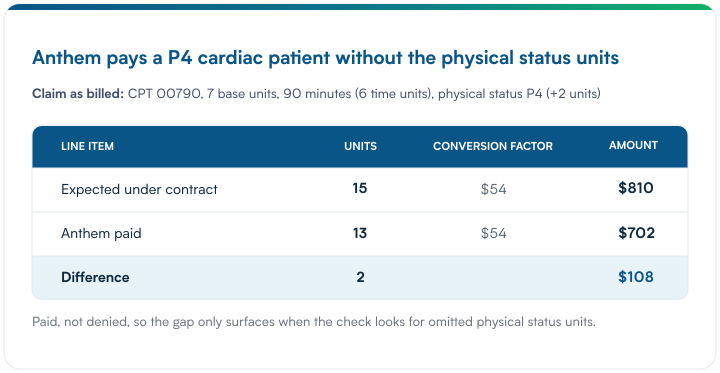
Consider a patient with a life-threatening heart condition undergoing complex surgery. The anesthesiologist reports a P4 physical status to reflect the added clinical risk. Under the applicable Anthem policy, that status qualifies for two additional units beyond the standard base and time units. The payer, however, processes the claim as though the case were routine and omits the P4 adjustment from the allowed amount. Nothing is denied and nothing is flagged, so the shortfall only surfaces when the comparison specifically checks for omitted physical status units.
Outdated model keeps adding physical status units Aetna no longer pays
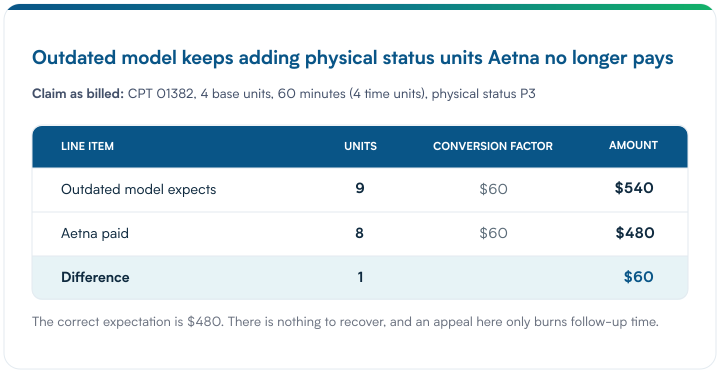
A patient undergoes a 60-minute knee surgery, and the anesthesiologist reports a P3 physical status code. An older audit model, built when Aetna reimbursed an additional unit for P3, expects extra payment for the code and flags a $60 underpayment. Under Aetna’s current policy, P3 is no longer reimbursed separately because it is already built into the negotiated payment rate. The $480 payment matches the contract, so the audit tool’s warning is a false positive. Following up on the claim would only waste time because the appeal would be denied and the payment was correct from the start.
Anthem correctly bundles one code but misses another payment
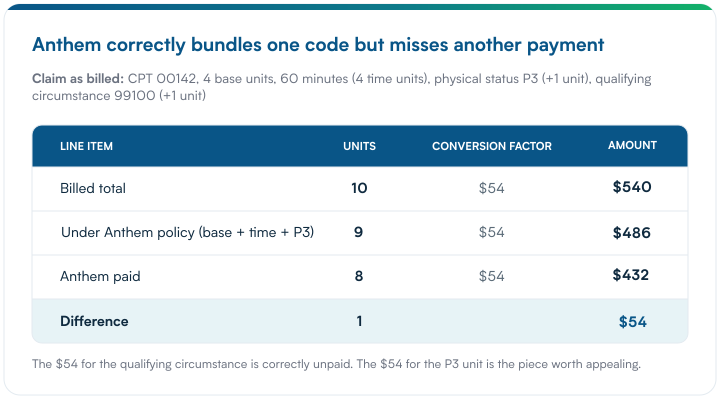
An 82-year-old comes in for cataract surgery. The claim includes two additional codes: one for extreme age and another for P3 physical status. Anthem bundles the extreme-age code into the base payment, so it won't pay separately. However, Anthem does pay for the P3 status. When Anthem misses both units, the claim appears to have a $108 shortfall. In reality, only $54 of that (the P3 portion) is a true underpayment. If you treat all missing units as the same, you’ll either overstate your recovery or mistakenly write off money you are actually owed.
Individually, these examples may represent only a few dozen dollars on a claim. Across hundreds or thousands of anesthesia cases each month, those seemingly minor variances can quietly become tens or even hundreds of thousands of dollars in missed revenue. The challenge is that most of these claims never look problematic. They are paid, closed, and disappear into the payment history unless someone verifies that every component of the reimbursement calculation was applied correctly.
When correct policy still produces an incorrect payment
Understanding the rules is only half the battle. The next is determining whether those rules were actually applied correctly on every claim. Each of the policy differences discussed above can create underpayments that never trigger a denial. The claim processes, a payment is issued, and the remittance appears complete. Yet a physical status unit may have been omitted, a qualifying circumstance code incorrectly excluded, or the wrong conversion factor applied. The money is missing, but nothing in a standard denial workflow calls attention to it.
Turning payer rules into payment accuracy
An anesthesia claim is only paid correctly when the expected allowable is built from the exact rule that applied to that payer, product, state, and date of service.
RevFind compares actual payments against expected allowables using the applicable contract terms, conversion factors, provider modifiers, time calculation methodology, additional reimbursable units, and effective dates. PayerMonitor supports the contract side of that process by helping teams locate and interpret the agreement terms behind the calculations. Together, they allow revenue cycle teams to move beyond asking whether a claim was paid and determine whether every part of the anesthesia reimbursement calculation was applied correctly.
A paid claim is not necessarily an accurately paid claim. Schedule a demo to see how RevFind and PayerMonitor help your team validate every component of the reimbursement calculation, uncover hidden underpayments, and recover revenue owed under your contracts.
FAQs
Get paid in full by bringing clarity to your revenue cycle
Related Posts

.avif)
Subscribe to the

Healthcare Clarified newsletter
Get the latest insights on RCM and healthcare policy in your inbox
