
CobbleStone vs MD Clarity PayerMonitor: A Healthcare Contract Management Software Comparison
.avif)
.svg)
CobbleStone Contract Insight and MD Clarity's PayerMonitor are both AI-powered contract platforms - but they were built for fundamentally different organizations and use cases. CobbleStone is a 30-year-old enterprise contract management platform with deep configurability, both SaaS and on-premises deployment options, and a broad procure-to-pay suite that extends well beyond CLM. PayerMonitor is a healthcare-purpose-built contract management platform focused specifically on payer agreements and reimbursement enforcement.
If your contract problem looks like enterprise-wide contracting across legal, procurement, vendor management, and eSourcing - with the configurability to model any process and the option for on-premises deployment - CobbleStone is a strong fit. If your contract problem looks like payer agreements with hidden underpayments and reimbursement terms buried in 200-page PDFs, PayerMonitor was built for exactly that.
This guide breaks down where each platform wins, how they compare across the dimensions buyers actually evaluate, and how to decide which fits your needs.
TL;DR - The Quick Verdict
- Choose CobbleStone Contract Insight if you're an enterprise that needs a highly configurable CLM platform with deep procure-to-pay capabilities, the option for on-premises deployment, and the willingness to invest in a longer learning curve to unlock the platform's full configurability.
- Choose MD Clarity PayerMonitor if your priority is payer contract management - extracting reimbursement terms, catching underpayments, and turning agreements into operational tools - with healthcare-purpose-built AI, self-serve onboarding, and transparent published pricing.
- They're built for different organizations. CobbleStone sits with enterprise legal, procurement, and IT teams who value configurability and deployment flexibility. PayerMonitor sits with revenue cycle, managed care, and finance leadership in healthcare provider organizations.
At-a-Glance Comparison
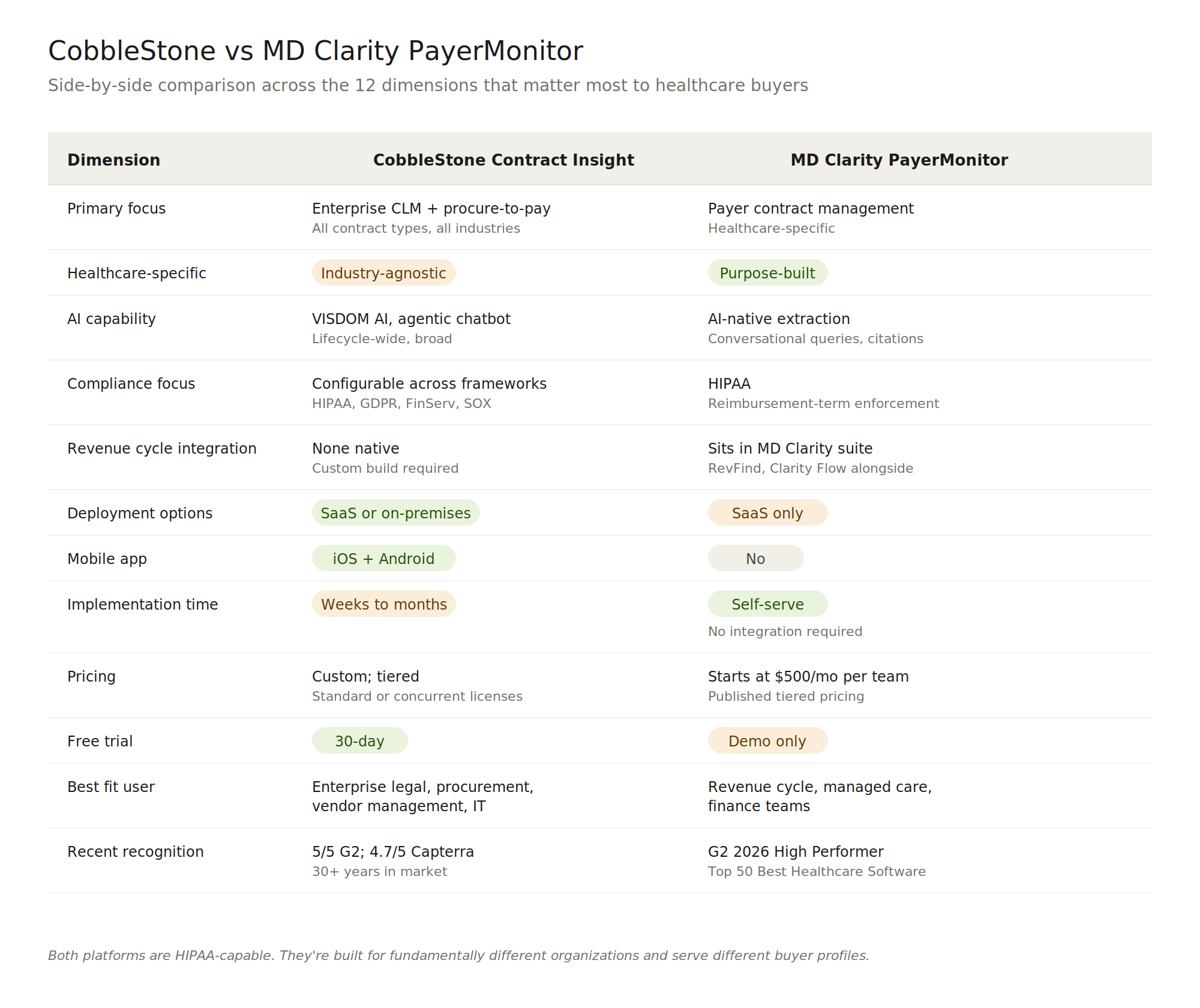
What CobbleStone Does Well
CobbleStone Software is one of the longest-tenured contract management vendors in the market. Founded in the mid-1990s by Mark Nastasi (who built one of the first commercial contract software platforms, the Contract Management Tracking System), the company has spent more than 30 years refining its CLM platform. Today, CobbleStone Contract Insight is an end-to-end platform covering contract management, vendor management, eSourcing, procurement, and risk management - with VISDOM AI as the company's flagship intelligence engine across all of it.
Where CobbleStone is strongest:
- Patented VISDOM AI. CobbleStone's proprietary VISDOM AI is the platform's intelligence backbone, automating data extraction, risk assessment, clause recommendations, sentiment analysis, and contract optimization. VISDOM also powers the platform's agentic AI chatbot that lets users query contract information and generate contracts through natural language conversation.
- Deep configurability. Reviewers consistently praise CobbleStone's flexibility. The platform handles essentially any contracting process through configurable workflows, custom data fields, role-based permissions, and customizable templates - useful for organizations that need to model unique contract types or industry-specific processes.
- Both SaaS and on-premises deployment. CobbleStone offers both cloud and on-premises deployment, which is increasingly rare in the modern CLM market. For organizations with strict data residency requirements, security policies, or regulatory environments that mandate on-premises systems, this flexibility is a meaningful differentiator.
- Procure-to-pay breadth. Beyond CLM, CobbleStone offers vendor management, eSourcing, purchase order management, requisition workflows, and supplier scorecards - all unified on one platform. For procurement-heavy organizations that want a single vendor across the source-to-contract-to-pay lifecycle, this breadth is genuinely useful.
- Native mobile app. CobbleStone offers a dedicated mobile app on both iOS and Android - a feature many CLM competitors don't provide.
- Native eSignature (IntelliSign). CobbleStone includes its own native eSignature platform integrated into the CLM, eliminating the need for a separate signing tool subscription.
- Strong customer support reputation. Reviews consistently praise CobbleStone's customer support team for responsiveness and willingness to help with complex configurations.
- Free trial. Unlike most enterprise CLMs, CobbleStone offers a 30-day free trial across CLM, Vendor Management, Bid Management & eSourcing, and Procurement solutions - meaningful for organizations that want to validate fit before committing.
- Strong analyst and review ratings. CobbleStone holds 5/5 on G2 and 4.7/5 on Capterra, with consistently high marks for customizability and ease of use after onboarding.
Where CobbleStone's challenges show up for healthcare:
- Not healthcare-specific. CobbleStone serves multiple industries - government, healthcare, legal, education, pharma/life sciences, financial services, and BFSI. The platform doesn't include healthcare-specific contract types, payer agreement templates, Stark/AKS compliance workflows, or exclusion list integration. Healthcare deployments require configuration on top of the general platform.
- No payer reimbursement focus. CobbleStone doesn't extract structured payer reimbursement terms (DRGs, lesser-of, stop-loss, escalators, timely filing limits), benchmark them across payers, model rate scenarios, or feed contract terms into underpayment detection. The recently-launched Contract Pricing Agent automates renewal pricing and percentage-based escalations - useful for general business renewals, but not the same as healthcare payer reimbursement enforcement.
- Learning curve flagged by reviewers. Multiple G2, Capterra, and Software Advice reviews note CobbleStone has "a bit of a learning curve" and that the interface can feel overwhelming initially. Reviewers describe the experience as "tough to use at first" until users build familiarity with the platform's extensive configuration options.
- Initial setup can be complex. Reviewers note that "the initial import of legacy contracts and the setup of custom templates can require more in-depth technical support" - the trade-off of CobbleStone's deep configurability is that early-stage configuration takes time and expertise.
- VISDOM AI works best in English. A Capterra reviewer noted that "Cobblestone AI solution with VISDOM needs more work to get better at pulling contract data in more languages" - relevant for organizations with multinational contract portfolios.
- Best fit is configuration-comfortable enterprise teams. CobbleStone's product, deployment model, and support approach center on enterprise legal, procurement, and IT teams who can invest in configuration. Healthcare provider organizations whose primary contract concern is payer reimbursement will find a horizontal CLM's positioning unfamiliar to revenue cycle workflows.
What MD Clarity PayerMonitor Does Well
PayerMonitor takes a fundamentally different approach. Rather than serving every contract need across an enterprise, it goes deep on the most financially material contracts in healthcare: payer agreements. A single managed care contract can be worth hundreds of millions of dollars in revenue, yet most provider organizations still manage payer contracts in spreadsheets, shared drives, or in a generalist CLM that treats them like every other document.
Where PayerMonitor is strongest:
- Healthcare-purpose-built. PayerMonitor was designed from the ground up for healthcare reimbursement. The AI is trained on the language hospitals actually contend with - DRGs, carve-outs, lesser-of provisions, stop-loss, escalators, timely filing limits - and recognizes how different payers phrase the same term.
- Citation traceability. Every extracted term and AI-generated answer is linked to a snippet in the source contract. When a managed care director is preparing for a renegotiation, or a billing team is fighting a denial, they can verify the source instantly.
- Self-serve onboarding. PayerMonitor requires no system integration to deliver value. Teams sign up, upload contracts, and the AI begins extracting structured terms immediately. There's no IT project, no professional services engagement, no months-long configuration.
- Conversational AI with citations. Staff can ask plain-language questions about contracts and get answers backed by source citations, without scrolling through 200-page PDFs.
- MD Clarity suite integration. PayerMonitor sits within MD Clarity's broader revenue platform alongside RevFind (underpayment detection, denial management, contract modeling) and Clarity Flow (patient estimates) - providing a unified contract foundation that informs reimbursement enforcement.
- Transparent published pricing with unlimited users. PayerMonitor publishes its pricing publicly: Starter at $500/month per team, Professional at $1,850/month, custom Enterprise. Every tier includes the full AI feature set and unlimited users.
- Third-party recognition. G2 named MD Clarity to its 2026 Best Software Awards on the Top 50 Best Healthcare Software Products list - one of only two revenue cycle platforms - alongside High Performer recognition in G2's Grid for revenue cycle management.
Where PayerMonitor's gaps show up:
- Not a full-portfolio CLM. PayerMonitor isn't built to manage NDAs, vendor contracts, sales agreements, employment paperwork, or any of the dozens of contract types CobbleStone handles natively. If your organization needs one platform to govern every contract type from sales to procurement to HR, PayerMonitor isn't designed for that scope.
- No procure-to-pay capabilities. CobbleStone's vendor management, eSourcing, and procurement modules cover workflows PayerMonitor doesn't address. PayerMonitor is exclusively focused on managing already-executed payer contracts.
- No on-premises deployment option. PayerMonitor is a cloud-only SaaS product. Organizations with strict data residency requirements that mandate on-premises systems would need CobbleStone or another vendor that offers deployed solutions.
- No external API at this time. PayerMonitor is a standalone product designed for self-serve use; there's no API for custom integrations beyond the MD Clarity suite.
- No native eSignature or mobile app. PayerMonitor doesn't include eSignature workflows or a dedicated mobile app - it's a web-based platform for managing executed payer contracts.
- Best fit is revenue cycle and managed care. Enterprise legal-driven shopping processes that prioritize procurement integration and configurability will find PayerMonitor's positioning unfamiliar.
Side-by-Side: Feature Comparison
Contract centralization and search
Both platforms centralize contracts in searchable repositories with version control. CobbleStone's strength is breadth and configurability - managing every contract type with customizable data fields, custom workflows, and a mature audit trail across the full procure-to-pay lifecycle. PayerMonitor's strength is depth on payer agreements specifically - every payer contract is structured the same way, with reimbursement terms automatically extracted into comparable fields. A managed care director can compare timely filing limits across five payers in a single view, without configuring custom data fields.
AI capabilities
Both platforms invest heavily in AI, but on different strategies. CobbleStone's VISDOM AI is the company's proprietary engine covering data extraction, risk assessment, clause recommendations, sentiment analysis, and an agentic chatbot for natural-language contract queries. The newer Contract Pricing Agent automates renewal pricing and percentage-based escalations - useful for general business renewals. PayerMonitor's AI is purpose-trained on healthcare reimbursement language, with citation-traceable outputs and structured term extraction tuned to payer contracts. CobbleStone's AI is broader and configurable; PayerMonitor's is deeper for the healthcare payer use case.
Deployment options
This is one of CobbleStone's clearest single advantages over PayerMonitor and most other modern CLMs. CobbleStone offers both SaaS and on-premises deployment options - meaningful for organizations with strict data residency requirements, security policies that mandate self-hosting, or regulatory environments that prohibit cloud deployment. PayerMonitor is cloud-only SaaS. For most healthcare providers, SaaS is the preferred deployment model, but organizations with specific on-premises mandates need to factor this into their decision.
Compliance
CobbleStone's approach to compliance is configurability - the platform supports many regulatory frameworks (HIPAA, GDPR, financial services regulations, Sarbanes-Oxley, anti-corruption frameworks) but you'll need to configure it for your environment. PayerMonitor focuses on HIPAA and reimbursement-term enforcement out of the box. Neither platform is the right answer if your primary compliance question is around Stark/AKS provider relationships - that's better served by a healthcare-purpose-built compliance CLM like symplr or Ntracts. CobbleStone is best when compliance is one of many contract concerns and you have IT resources to configure it; PayerMonitor is best when reimbursement enforcement is the priority.
Revenue cycle integration
This is the largest functional gap between the two platforms. CobbleStone has no native healthcare revenue cycle integration - it's not designed to feed contract terms into claim-level systems, underpayment detection, or denial management. Customers wanting this connection would need to build it as a custom integration. PayerMonitor sits within MD Clarity's broader revenue platform alongside RevFind for underpayment detection, denial management, and contract modeling. Payer contracts in PayerMonitor flow into operational revenue tools without integration effort.
Mobile and accessibility
CobbleStone offers dedicated iOS and Android mobile apps for on-the-go contract management - a real differentiator versus most modern CLMs. PayerMonitor is a web-based platform without a mobile app. For sales or procurement teams that need to access contracts in the field, CobbleStone's mobile experience is a meaningful advantage. For revenue cycle and managed care teams, mobile access is typically less critical to the core workflow.
Implementation and time-to-value
CobbleStone implementations vary significantly based on configuration scope. Standard deployments take weeks to a few months, with reviewers noting that "the initial import of legacy contracts and the setup of custom templates can require more in-depth technical support." The platform's deep configurability is both a strength and an implementation factor - more configuration means longer time to first value, even though the long-term flexibility pays off.
PayerMonitor takes a fundamentally different approach: self-serve onboarding with no integration required. Teams subscribe, upload contracts, and AI extraction begins immediately. There's no IT project, no professional services engagement, and no learning curve barrier to first value.
Pricing
CobbleStone uses custom enterprise pricing with no published list. The platform offers tiered pricing with options for either standard user licenses or concurrent user licenses, and pricing scales with organization size, contract volume, modules deployed, and integration scope. CobbleStone does offer a 30-day free trial, which is unusual for enterprise CLMs and helpful for evaluation before committing.
MD Clarity publishes PayerMonitor pricing publicly:
- Starter - $500/month per team (25 documents, 50 questions/month, unlimited users)
- Professional - $1,850/month per team (150 documents, 250 questions/month, unlimited users, priority support)
- Enterprise - custom pricing for larger health systems with high contract volume
Every tier includes the full AI feature set and unlimited users, with no implementation fees and predictable billing.
Free trial and evaluation
This is one area where CobbleStone has an evaluation advantage over many enterprise CLMs - and over PayerMonitor. CobbleStone offers a 30-day free trial across CLM, Vendor Management, Bid Management & eSourcing, and Procurement solutions, letting buyers self-serve evaluate before committing. PayerMonitor offers demos on request rather than a self-service free trial. For organizations that prefer hands-on evaluation, CobbleStone's free trial is a meaningful differentiator.
Use Case Decision Framework
Three questions will narrow your shortlist faster than any feature comparison.
Pick CobbleStone Contract Insight if you can answer "yes" to most of these:
- You need a CLM that handles all contract types - sales, procurement, NDAs, employment, vendor agreements
- Procure-to-pay capabilities (vendor management, eSourcing, purchase orders) are part of your contract function
- Deep configurability and the ability to model unique workflows is a priority
- On-premises deployment is required or strongly preferred for security/regulatory reasons
- You have IT capacity to support a configuration-heavy implementation
- Enterprise legal, procurement, or IT leadership owns the buying decision
- Native mobile app and a free trial matter to your evaluation process
Pick MD Clarity PayerMonitor if you can answer "yes" to most of these:
- Your most pressing contract problem is payer reimbursement and revenue leakage
- You want a healthcare-purpose-built platform, not a horizontal CLM with healthcare templates
- You need to be live immediately - self-serve onboarding, no IT or configuration project required
- You want transparent, published pricing with unlimited users at every tier
- Revenue cycle, managed care, or finance leadership owns the buying decision
- Your payer contracts are already executed (procurement and eSourcing aren't your problem)
Use both if:
- You're a large healthcare organization where enterprise contracting and procurement (CobbleStone's strengths) live separately from payer contract management (PayerMonitor's specialty)
- Your IT or legal team has already deployed CobbleStone for procure-to-pay workflows but the revenue cycle team needs purpose-built payer contract tooling
- Different teams own different contract types and benefit from purpose-fit tools rather than forcing payer contracts through a horizontal enterprise CLM
This is a less common pattern than with vendor-CLM-focused platforms, because organizations large enough to deploy CobbleStone enterprise-wide often configure it to attempt to handle payer contracts as well. But the largest provider organizations sometimes still prefer a specialized tool for their most financially material contract type.
Customer Profile: Who Buys What
CobbleStone customers span government, healthcare, legal, education, pharma/life sciences, financial services, and BFSI sectors. The unifying characteristics: mid-to-large enterprises (and some small businesses) with sophisticated procurement and legal functions, often with IT capacity to support a configurable platform, and sometimes with on-premises deployment requirements that rule out cloud-only competitors. CobbleStone is particularly strong with public sector organizations, regulated industries, and procurement-led contract operations.
MD Clarity customers range from small specialty groups and ASCs at the Starter tier through large hospitals and health systems, physician groups, and IDNs at the Professional and Enterprise tiers. The common thread is a sophisticated revenue cycle or managed care function that views payer contracts as financial instruments - not just legal documents. MD Clarity now serves more than 150,000 providers nationwide, and its tiered pricing model makes it accessible to a much broader range of provider organizations than enterprise CLMs typically reach.
Frequently Asked Questions
Are CobbleStone and MD Clarity PayerMonitor direct competitors?
Not really. CobbleStone is an enterprise horizontal CLM with deep procurement and configurability strengths. PayerMonitor is healthcare-purpose-built for managing payer agreements specifically. Some healthcare organizations evaluate both, but most use them for different jobs.
Can CobbleStone handle healthcare contracts?
Yes - CobbleStone serves healthcare organizations and can store and manage any healthcare contract document. What it doesn't include are healthcare-specific contract templates, Stark/AKS compliance workflows, exclusion list integration, or payer reimbursement-term extraction. Those need to be configured on top of the platform.
Can MD Clarity PayerMonitor replace CobbleStone?
For payer contract management, yes - and more deeply, because PayerMonitor was purpose-built for that use case. For an organization that also needs procure-to-pay, vendor management, eSourcing, full contract lifecycle workflows across NDAs, sales agreements, and other contract types, PayerMonitor isn't designed to replace that broader scope.
Which platform deploys faster?
PayerMonitor, by a significant margin. It's a self-serve platform with no integration requirement - teams sign up, upload contracts, and AI extraction starts immediately. CobbleStone implementations typically take weeks to months, with the configuration-heavy nature of the platform extending timelines for complex deployments.
Which platform has better AI?
They're optimized for different scopes. CobbleStone's VISDOM AI is broad - covering extraction, risk assessment, clause recommendations, sentiment analysis, and an agentic chatbot for natural-language queries across all contract types. PayerMonitor's AI is purpose-trained on healthcare reimbursement language with citation-traceable outputs and structured term extraction tuned to payer contracts. The "better" AI depends on which job you're trying to do.
How much do they cost?
CobbleStone uses custom pricing with tiered options for standard or concurrent user licenses, varying by organization size, modules, and deployment model. PayerMonitor publishes its pricing: Starter at $500/month per team, Professional at $1,850/month, custom Enterprise - every tier with unlimited users, full AI feature set, and no implementation fees.
Does either platform offer a free trial?
CobbleStone offers a 30-day free trial across CLM, Vendor Management, Bid Management & eSourcing, and Procurement solutions - unusually generous for enterprise CLM vendors. PayerMonitor offers demos on request rather than a self-service free trial.
Does either platform offer on-premises deployment?
CobbleStone is one of the few CLMs that still offers both SaaS and on-premises deployment options - meaningful for organizations with strict data residency or security requirements. PayerMonitor is cloud-only SaaS.
Do they have mobile apps?
CobbleStone offers dedicated iOS and Android mobile apps for on-the-go contract management. PayerMonitor is a web-based platform without a dedicated mobile app.
Do they integrate with my EHR or other systems?
CobbleStone offers integrations with Microsoft Word/Outlook (prebuilt plug-in), Excel, and various enterprise systems. PayerMonitor is intentionally standalone with no external API at this time. For organizations using MD Clarity's broader revenue platform (RevFind, Clarity Flow), PayerMonitor sits naturally alongside those products. Claim-level integration with billing systems is handled by other modules of the MD Clarity platform.
The Bottom Line
If you're trying to pick between CobbleStone Contract Insight and MD Clarity PayerMonitor, the honest framing is that they were built for different organizations solving different contract problems.
CobbleStone is a mature, deeply configurable enterprise CLM with 30+ years of market presence, a broad procure-to-pay platform, and real differentiation through on-premises deployment options, native mobile apps, and a 30-day free trial. For enterprises that need configurable contracting across procurement, vendor management, and legal - especially in regulated industries or public sector environments - CobbleStone's combination of breadth, configurability, and deployment flexibility is a strong fit.
PayerMonitor is healthcare-purpose-built contract management focused on the contract type that drives provider revenue: payer agreements. If you want a platform engineered specifically for payer contracts, with healthcare-purpose-trained AI, citation-traceable outputs, transparent published pricing, and direct connections to revenue cycle workflows that catch underpayments and inform negotiations - PayerMonitor was built for that exact problem.
For most provider organizations, payer contracts are the largest financial lever in the business. A single underpaid contract clause can leak millions of dollars per year - invisible without the right tooling. That's the gap PayerMonitor was built to close, with a price point and deployment model far more accessible than enterprise CLM platforms.
Ready to see PayerMonitor in action? Request a demo from MD Clarity to see how AI-native payer contract management can turn your agreements into recovered revenue.
Get paid in full by bringing clarity to your revenue cycle
Related Posts


Subscribe to the

Healthcare Clarified newsletter
Get the latest insights on RCM and healthcare policy in your inbox
