
.avif)
.svg)
Icertis and MD Clarity's PayerMonitor sit on opposite ends of the contract software market. Icertis is one of the world's most established enterprise contract lifecycle management (CLM) platforms - a Gartner Magic Quadrant Leader trusted by a third of the Fortune 100 to manage more than 10 million contracts worth over $1 trillion. PayerMonitor is a healthcare-purpose-built contract management platform focused specifically on payer agreements and reimbursement enforcement.
Both can manage payer contracts. But how they do it - and what kind of organization each is built for - couldn't be more different. This guide breaks down where each platform wins, how they compare across the dimensions that matter to healthcare buyers, and how to decide which fits your needs.
TL;DR - The Quick Verdict
- Choose Icertis if you're a Fortune-class health system or IDN that needs an enterprise-wide CLM platform across all contract types - supplier, physician, payer, clinical trial - with deep customization, ERP/SAP integration, and the IT capacity to support a 6–12 month implementation.
- Choose MD Clarity PayerMonitor if your priority is payer contract management - extracting reimbursement terms, catching underpayments, and turning agreements into operational tools - and you want a healthcare-purpose-built platform with self-serve onboarding and published pricing.
- The size of your organization matters. Icertis is engineered for the largest enterprises in the world. PayerMonitor scales from single-specialty groups and ASCs up through large IDNs, with a Starter tier accessible to organizations Icertis was never priced for.
At-a-Glance Comparison
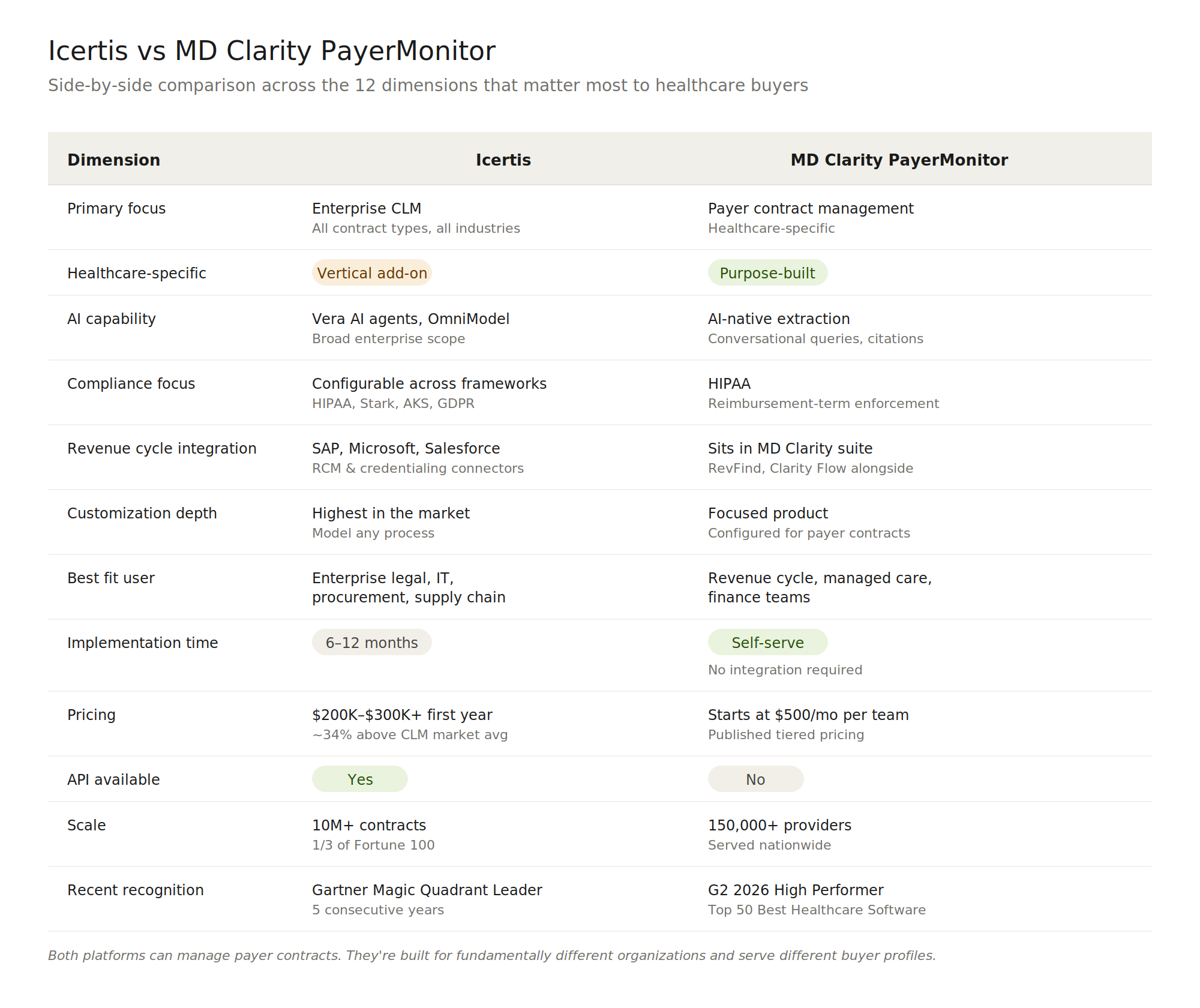
What Icertis Does Well
Icertis is the gold standard in enterprise contract lifecycle management. Founded in 2009 as a horizontal CLM platform, it has spent 15+ years adding sophistication, integrations, and AI capabilities - and has been named a Gartner Magic Quadrant Leader for five consecutive years alongside Leader status in the Forrester Wave for CLM platforms. In 2022, the company launched Icertis Contract Intelligence (ICI) for Healthcare Providers, a vertical solution with pre-configured contract types and AI models for payer, physician, supplier, and clinical education agreements.
Where Icertis is strongest:
- AI depth. The Vera AI engine includes agentic workflows, an OmniModel architecture letting customers use the LLM of their choice, and an AI Copilot built on Microsoft Azure OpenAI Service. For enterprises with mature AI governance frameworks, this depth is unmatched.
- Enterprise integration. Tight integration with SAP, Microsoft, Salesforce, Workday, and SAP Ariba - including a co-innovated Ariba embedded experience. For companies running on these platforms, contracts flow directly into procurement, finance, and CRM workflows.
- Configurability and scale. Icertis can model essentially any contracting process - including complex relationships like connecting SOWs to MSAs at enterprise scale. It's the most customizable enterprise CLM on the market.
- Healthcare vertical capabilities. ICI for Healthcare Providers includes pre-configured contract types (payer, physician, supplier), AI-powered analysis of reimbursement terms, dashboards for benchmarking payer and supplier contracts, and obligation tracking across physician, supplier, and payer agreements.
- Recognition and trust. Trusted by one-third of the Fortune 100, 4.2/5 on G2 (82 reviews), 4.4/5 on Capterra, and 93% recommendation rate on Gartner Peer Insights.
- Global reach. Supports 40+ languages and 93+ currencies - the strongest global footprint of any CLM vendor.
Where Icertis' challenges show up:
- Long implementation timelines. Implementations typically take 6–12 months, a recurring theme in user reviews. This is the longest implementation cycle of any major CLM vendor.
- Enterprise pricing. First-year costs typically run $200,000 to $300,000 when implementation, training, and licensing are combined - roughly 34% above the CLM market average according to G2 data.
- Steep learning curve. Reviewers consistently flag a complex interface and meaningful training requirement. Icertis is an enterprise tool that rewards investment in expertise, not a self-serve platform users adopt in an afternoon.
- Generalist DNA. Icertis was built as a horizontal CLM and has added healthcare as a vertical solution. The healthcare functionality is real and capable, but the platform's core model - architecture, pricing, deployment philosophy - reflects its enterprise-wide roots, not healthcare-native design.
- Customization can be a trap. Multiple reviewers note that the platform's flexibility allows extensive customization, but those customizations become difficult to maintain through upgrades and can extend implementation timelines further.
What MD Clarity PayerMonitor Does Well
PayerMonitor takes a fundamentally different approach. Rather than serving every contract need across an enterprise, it goes deep on the most financially material contracts in healthcare: payer agreements. A single managed care contract can be worth hundreds of millions of dollars in revenue, yet most organizations still manage payer contracts in spreadsheets or shared drives. PayerMonitor exists to fix that problem specifically.
Where PayerMonitor is strongest:
- Healthcare-purpose-built. PayerMonitor was designed from the ground up for healthcare reimbursement. The AI is trained on the language hospitals actually contend with - DRGs, carve-outs, lesser-of provisions, stop-loss, escalators, timely filing limits - and recognizes how different payers phrase the same term. There's no horizontal-CLM scaffolding to work around.
- Citation traceability. Every extracted term and AI-generated answer is linked to a snippet in the source contract. When a managed care director is preparing for a renegotiation, or a billing team is fighting a denial, they can verify the source instantly.
- Self-serve onboarding. PayerMonitor requires no system integration to deliver value. Teams sign up, upload contracts, and the AI begins extracting structured terms immediately. There's no IT project, no professional services engagement, no 6–12 month rollout.
- Conversational AI with citations. Staff can ask plain-language questions about contracts and get answers backed by source citations, without scrolling through 200-page PDFs.
- MD Clarity suite integration. PayerMonitor sits within MD Clarity's broader revenue platform alongside RevFind (underpayment detection, denial management, contract modeling) and Clarity Flow (patient estimates) - providing a unified contract foundation that informs reimbursement enforcement.
- Published pricing. PayerMonitor publishes its pricing publicly: Starter at $500/month per team, Professional at $1,850/month, custom Enterprise. Every tier includes the full AI feature set and unlimited users - making procurement and budgeting substantially easier than negotiating an enterprise CLM contract.
- Third-party recognition. G2 named MD Clarity to its 2026 Best Software Awards on the Top 50 Best Healthcare Software Products list - one of only two revenue cycle platforms - alongside High Performer recognition in G2's Grid for revenue cycle management.
Where PayerMonitor's gaps show up:
- Not a full-portfolio CLM. PayerMonitor isn't built to manage vendor contracts, BAAs, supply chain agreements, or provider compensation contracts. If you need one platform to govern every contract type from clinical trial agreements to procurement contracts to NDAs, PayerMonitor isn't designed for that scope.
- No external API at this time. PayerMonitor is a standalone product designed for self-serve use; there's no API for custom integrations beyond the MD Clarity suite.
- Less customization depth. PayerMonitor is a focused product, not a configuration platform. If your organization wants to model an entirely custom approval workflow with conditional logic, Icertis offers more flexibility.
- Best fit is revenue cycle and managed care. Legal-driven enterprise procurement teams accustomed to Icertis-style flexibility may find PayerMonitor's product approach unfamiliar.
Side-by-Side: Feature Comparison
Contract centralization and search
Both platforms centralize contracts in searchable repositories with version control. Icertis' strength is breadth - managing 10M+ contracts across all types, with the ability to model complex relationships (e.g., connecting SOWs to MSAs) at enterprise scale. PayerMonitor's strength is depth on payer agreements specifically - every contract is structured the same way, with reimbursement terms automatically extracted into comparable fields. A managed care director can compare timely filing limits across five payers in a single view, without writing custom queries or navigating an enterprise data model.
AI capabilities
Both platforms invest heavily in AI, but on different strategies. Icertis offers Vera AI with agentic workflows, OmniModel architecture (use the LLM of your choice), AI playbooks for redlining, and Copilot for portfolio-wide queries. It's a sophisticated AI platform built to match the breadth of enterprise CLM use cases. PayerMonitor's AI is purpose-trained on reimbursement language. It extracts structured payer contract terms with citation-traceable outputs, supports natural-language queries, and is tuned to recognize how different payers express the same concept. Icertis' AI is broader; PayerMonitor's AI is deeper on the payer use case.
Compliance
Icertis' approach to compliance is configurability - the platform supports any regulatory framework you can model (HIPAA, Stark, AKS, GDPR, anti-corruption, etc.) but you'll need to configure it for your environment. PayerMonitor focuses on HIPAA, secure architecture, and reimbursement-term enforcement out of the box. For organizations whose biggest compliance question is "are we collecting what our payer contracts entitle us to?" - that's PayerMonitor's territory by default. For organizations with diverse compliance frameworks across procurement, employment, supplier risk, and payer contracts - Icertis can handle all of it, given the configuration investment.
Revenue cycle integration
This is where the two diverge sharply. Icertis integrates with revenue cycle management platforms, credentialing systems, and ERP platforms - it can ingest fee schedules, link physician NPIs, and surface reimbursement terms in dashboards. The integration story is strong, but it requires implementation work. PayerMonitor sits within MD Clarity's broader revenue optimization platform alongside RevFind for underpayment detection, denial management, and contract modeling. For organizations adopting MD Clarity's full stack, payer contracts in PayerMonitor flow into operational revenue tools without integration effort. For organizations with mature ERP/SCM stacks they want to keep, Icertis offers more integration breadth.
Implementation and time-to-value
This is the largest practical gap between the two platforms. Icertis implementations typically take 6–12 months, reflecting the complexity of enterprise CLM rollouts - data migration, workflow configuration, custom development, integration with surround systems, and user training. The result is a deeply embedded enterprise system, but the runway to first value is long. PayerMonitor takes the opposite approach: self-serve onboarding with no integration required. Teams subscribe, log in, and upload contracts. AI extraction begins immediately, and time-to-value is essentially gated only by how fast the team can collect and upload its contract portfolio. There's no IT project required to start getting use out of the platform.
Pricing
Icertis uses custom enterprise pricing, with first-year costs typically $200,000 to $300,000 when licensing, implementation, and training are combined - roughly 34% above the CLM market average. This pricing model reflects Icertis' positioning as a Fortune-class enterprise platform.
MD Clarity publishes PayerMonitor pricing publicly:
- Starter - $500/month per team (25 documents, 50 questions/month, unlimited users)
- Professional - $1,850/month per team (150 documents, 250 questions/month, unlimited users, priority support)
- Enterprise - custom pricing for larger health systems with high contract volume
Every tier includes the full AI feature set and unlimited users. The Starter tier is accessible to single-specialty groups, ASCs, and smaller practices that Icertis was never priced for. Even at the Enterprise tier, PayerMonitor's pricing model is fundamentally different - focused on payer contract management rather than enterprise-wide CLM.
Customization and platform philosophy
Icertis is a platform - extensive customization is both its greatest strength and its biggest implementation challenge. You can model essentially any contracting process, but doing so requires expertise and creates upgrade-path complexity. Multiple reviewers note that customizations made early can become difficult to maintain over time. PayerMonitor is a focused product - opinionated about the right way to manage payer contracts, with less surface area to customize and a correspondingly faster path to value. Different philosophies, different trade-offs.
Use Case Decision Framework
Three questions will narrow your shortlist faster than any feature comparison.
Pick Icertis if you can answer "yes" to most of these:
- You're a Fortune-class health system, IDN, or large multi-state provider with enterprise-wide contracting complexity
- You need one CLM platform across supplier, physician, payer, clinical trial, employment, and other contract types
- You have an annual CLM budget of $200K+ and IT capacity for a 6–12 month implementation
- You're standardized on SAP, Microsoft, Salesforce, or Workday and want tight ERP/CRM integration
- Legal, IT, or procurement leadership owns the buying decision
- You need extensive customization to model complex, organization-specific workflows
Pick MD Clarity PayerMonitor if you can answer "yes" to most of these:
- Your most pressing contract problem is payer reimbursement and revenue leakage
- You want a healthcare-purpose-built platform, not a horizontal CLM with healthcare bolted on
- You need to be live immediately - self-serve onboarding, no IT project
- You want transparent, published pricing rather than enterprise sales cycles
- Revenue cycle, managed care, or finance leadership owns the buying decision
- You're a small-to-large provider organization (specialty group, ASC, hospital, IDN) - not a Fortune-class enterprise
Use both if:
- You're a very large health system that has chosen Icertis as enterprise CLM but wants a best-of-breed payer contract management platform with built-in reimbursement enforcement that connects to underpayment detection
- You want Icertis governing the broader contract portfolio while PayerMonitor handles the specific payer use case alongside MD Clarity's revenue cycle stack
This is less common than the "use both" pattern with vendor-CLM-focused platforms, because Icertis' healthcare provider solution does include payer contract analytics. But the largest organizations sometimes still prefer a specialized tool for their most financially material contract type.
Customer Profile: Who Buys What
Icertis customers skew heavily toward Fortune-class enterprises across industries. The platform is trusted by more than a third of the Fortune 100 including Microsoft (220,000 employees enabled as procurement agents through Icertis). In healthcare, the customer base includes large health systems, payers, and life sciences companies that need enterprise-wide contracting infrastructure. The unifying characteristic: organizations large enough to justify a $200K+ annual investment and a 6–12 month implementation.
MD Clarity customers range from small specialty groups and ASCs at the Starter tier through large hospitals, physician groups, and IDNs at the Professional and Enterprise tiers. The common thread is a sophisticated revenue cycle or managed care function that views payer contracts as financial instruments, not just legal documents. MD Clarity now serves more than 150,000 providers nationwide, and its tiered pricing model makes it accessible to a much broader range of provider organizations than enterprise CLMs typically reach.
Frequently Asked Questions
Are Icertis and MD Clarity PayerMonitor direct competitors?
Partially. Both can manage payer contracts, but they're built for different organizations. Icertis is an enterprise CLM platform that added healthcare as a vertical solution and serves Fortune-class organizations across industries. PayerMonitor is a healthcare-purpose-built contract management platform focused specifically on payer agreements, accessible to a much broader range of provider organizations.
Can Icertis handle payer contracts?
Yes. Icertis launched ICI for Healthcare Providers in 2022, which includes pre-configured contract types for payer, physician, supplier, and clinical education agreements, plus AI-powered analytics for reimbursement terms and benchmarking. The capability is real. The trade-offs are implementation timeline (6–12 months), pricing (typically $200K+ first year), and the complexity of a horizontal CLM platform configured for healthcare.
Can MD Clarity PayerMonitor replace Icertis?
For payer contracts specifically, yes - and in many cases, more deeply, because PayerMonitor was purpose-built for that use case. For an organization that also needs a CLM across vendor contracts, supplier agreements, employment contracts, clinical trials, and other contract types, PayerMonitor isn't designed to replace that broader scope. Different products for different jobs.
Which platform deploys faster?
PayerMonitor, by a very wide margin. Icertis implementations typically take 6–12 months, reflecting the complexity of enterprise CLM rollouts. PayerMonitor is self-serve - teams sign up, upload contracts, and the AI starts extracting structured terms immediately. There's no IT project.
Which platform has better AI?
They're optimized for different scopes. Icertis' Vera AI is a sophisticated, agentic platform designed to handle the full breadth of enterprise contracting - drafting, redlining, playbook enforcement, portfolio queries, custom workflows. PayerMonitor's AI is purpose-trained on healthcare reimbursement language, with citation-traceable outputs, structured term extraction, and conversational queries focused on payer contracts. Icertis' AI is broader; PayerMonitor's is deeper for the payer use case.
How much do they cost?
Icertis uses custom enterprise pricing with first-year costs typically $200,000–$300,000 (licensing + implementation + training combined), running roughly 34% above the CLM market average. PayerMonitor publishes its pricing: Starter at $500/month per team, Professional at $1,850/month, custom Enterprise. The pricing models reflect fundamentally different positioning - Icertis as enterprise platform investment, PayerMonitor as accessible, transparent SaaS.
Do they integrate with my EHR or other systems?
Icertis offers extensive integration with SAP, Microsoft, Salesforce, Workday, ERP, RCM, and credentialing platforms. The integration story is one of its biggest enterprise strengths. PayerMonitor is intentionally standalone - there's no external API at this time and no EHR/ERP integration required. For organizations using MD Clarity's broader revenue platform (RevFind, Clarity Flow), PayerMonitor sits naturally alongside those products. Claim-level integration with billing systems is handled by other modules of the MD Clarity platform.
Is one HIPAA-compliant and the other not?
Both are HIPAA-compliant and built for enterprise security. The differences are in scope, deployment model, and which compliance frameworks each platform addresses by default versus through configuration.
Which platform is recognized by analysts?
Icertis has been named a Gartner Magic Quadrant Leader for CLM for five consecutive years and is a Forrester Wave Leader. MD Clarity was named to G2's 2026 Best Software Awards on the Top 50 Best Healthcare Software Products list and recognized as a G2 High Performer in revenue cycle management. The recognition reflects different categories - Icertis as a horizontal enterprise CLM leader, MD Clarity as a healthcare RCM leader.
The Bottom Line
If you're trying to pick between Icertis and MD Clarity PayerMonitor, the real question isn't which one is better. It's which one fits your organization.
Icertis is the gold standard for Fortune-class enterprise CLM. If you're a very large health system or IDN with enterprise-wide contracting complexity, the budget for a $200K+ first year, the IT capacity for a 6–12 month implementation, and the appetite for a deeply customizable platform - Icertis is built for exactly that.
PayerMonitor is healthcare-purpose-built contract management focused on the contract type that drives provider revenue: payer agreements. If you want a platform engineered specifically for payer contracts, with self-serve onboarding, transparent published pricing, and direct connections to revenue cycle workflows that catch underpayments and inform negotiations - PayerMonitor was built for that exact problem.
For most provider organizations, payer contracts are the largest financial lever in the business. A single underpaid contract clause can leak millions of dollars per year - invisible without the right tooling. That's the gap PayerMonitor was built to close, at a price point and deployment model accessible to organizations far beyond the Fortune 100.
Ready to see PayerMonitor in action? Request a demo from MD Clarity to see how AI-native payer contract management can turn your agreements into recovered revenue.
Get paid in full by bringing clarity to your revenue cycle
Related Posts

Subscribe to the

Healthcare Clarified newsletter
Get the latest insights on RCM and healthcare policy in your inbox
